
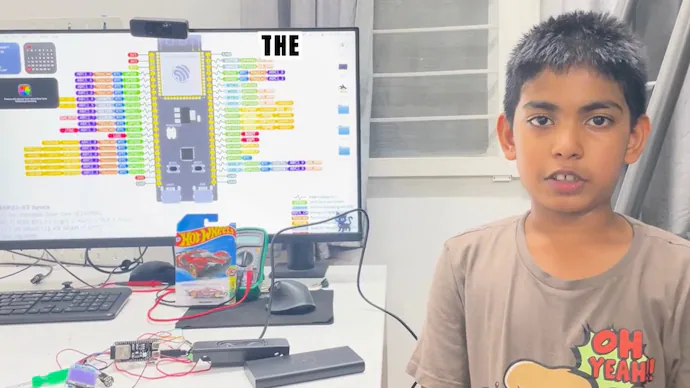
An eight-year-old innovator has created a compact offline AI storytelling device powered by a low-cost ESP32-S3 microcontroller, demonstrating how artificial intelligence can run entirely on affordable hardware without requiring internet connectivity or cloud computing.
The voice-controlled device generates original stories, narrates them aloud, displays simple animations, and responds to spoken commands—all while operating completely offline. The project highlights the growing potential of open-source AI models and edge computing for building accessible and cost-effective AI applications.
AI Storytelling Device Works Without Internet
The AI-powered storytelling system is built using an ESP32-S3 microcontroller, which costs approximately ₹760, along with several supporting components, including:
- ESP32-S3 microcontroller
- INMP441 digital microphone
- I2S speaker
- MAX98357A audio amplifier
Unlike many AI applications that rely on cloud servers or internet access, this device performs all processing directly on the hardware itself. It does not require Wi-Fi, APIs, or cloud-based services.
Users can interact with the device using voice commands, making it an entirely self-contained AI storytelling assistant.
Powered by an Open-Source Language Model
The project is based on an open-source language model known as TinyStories LLM for ESP32, originally designed to generate stories directly on the ESP32 microcontroller without an internet connection.
The young developer enhanced the original project by introducing several new capabilities, including:
- Voice-controlled interaction
- Story playback controls
- Animated visual display
- Improved user experience
These additions transformed the original language model into an interactive storytelling device capable of responding naturally to spoken instructions.
Voice Commands Make Storytelling Interactive
The AI system can understand simple spoken commands such as:
- Play
- Pause
- Resume
- Next Story
When asked to create a story, the device instantly generates an original narrative, reads it aloud using its built-in text-to-speech system, and displays simple animations during playback.
All of these functions operate entirely on the microcontroller without requiring any online processing.
Improving Text-to-Speech Is the Next Goal
While the storytelling system successfully generates and narrates stories offline, the current text-to-speech (TTS) voice remains relatively basic.
The next stage of development will focus on improving voice quality to create more natural and engaging narration while maintaining offline functionality.
Demonstrating the Power of Low-Cost Offline AI
The project showcases how open-source artificial intelligence models combined with inexpensive hardware can deliver practical AI applications without depending on cloud infrastructure.
It also demonstrates that compact language models are becoming increasingly capable of running directly on small embedded devices, opening possibilities for educational tools, smart gadgets, and AI-powered solutions in locations where internet access is limited or unavailable.
Key Highlights
- An 8-year-old developed an offline AI storytelling device using a ₹760 ESP32-S3 microcontroller.
- The AI operates entirely without Wi-Fi, cloud services, or APIs.
- It generates original stories, narrates them aloud, and displays simple animations.
- Users can control the device using voice commands like play, pause, resume, and next story.
- The project is based on the open-source TinyStories LLM for ESP32 language model.
- Improving offline text-to-speech quality is the next development goal.
FAQs
1. What is the offline AI storytelling device?
It is a voice-controlled AI system that generates and narrates stories entirely offline using an ESP32-S3 microcontroller.
2. Does the AI require an internet connection?
No. The device works completely offline without Wi-Fi, cloud computing, or external APIs.
3. Which microcontroller powers the project?
The storytelling device is powered by the ESP32-S3 microcontroller.
4. What hardware components are used?
The project uses an ESP32-S3 microcontroller, an INMP441 microphone, an I2S speaker, and a MAX98357A amplifier.
5. Which AI model does the device use?
It is based on the open-source TinyStories LLM for ESP32 language model.
6. What voice commands does the AI understand?
The device responds to commands such as play, pause, resume, and next story.
7. Can the AI generate stories on its own?
Yes. It creates original short stories locally on the device without internet access.
8. What is the current limitation of the project?
The offline text-to-speech voice quality is still basic and is planned to be improved in future versions.
9. Why is offline AI important?
Offline AI enhances privacy, reduces internet dependency, lowers operating costs, and allows AI tools to function in areas with limited connectivity.
10. What does this project demonstrate?
The project highlights how affordable hardware and open-source AI models can power capable edge AI applications without relying on cloud infrastructure.