
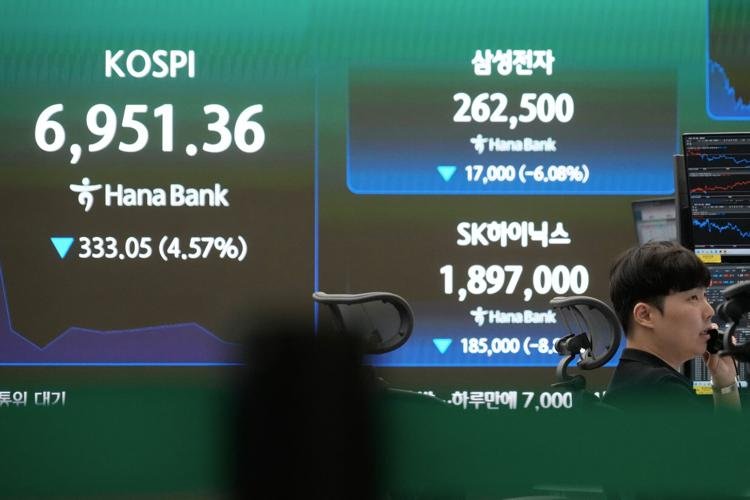
Asian stock markets witnessed broad declines on Wednesday as investor concerns over aggressive artificial intelligence (AI) spending weighed heavily on technology shares. South Korea experienced the sharpest losses, with semiconductor companies leading the market downturn, reflecting growing caution over AI-driven investments despite continued optimism in some sectors.
The South Korean Kospi Index plunged 8.2% to 5,531.56 during midday trading, reversing recent gains after briefly crossing the 9,000 mark and falling to its lowest level since early April.
Chipmakers Face Heavy Selling Pressure
Technology stocks bore the brunt of the sell-off, particularly semiconductor manufacturers.
SK Hynix dropped 12.6% after reporting quarterly operating profits that missed market expectations, despite posting a sixfold increase to a record 60.5 trillion won (USD 41.2 billion). Meanwhile, Samsung Electronics declined 8%, adding to pressure on South Korea’s technology-heavy market.
Investor sentiment weakened as concerns mounted over whether massive AI-related capital spending would continue delivering expected returns.
Mixed Performance Across Asian Markets
Japan’s Nikkei 225 fell 1.8% to 61,038.63 after surrendering early gains. Investors also monitored the impact of a powerful earthquake that struck the southern Kyushu region a day earlier. Shares of Nippon Paper, which operates a manufacturing facility in the affected area, slipped 1%.
Elsewhere across Asia:
- Taiwan’s Taiex Index declined 3.6%.
- China’s Shanghai Composite edged down 0.5% to 3,793.11.
- Hong Kong’s Hang Seng Index rose 1.7% to 25,738.42.
- Australia’s S&P/ASX 200 gained 1% to 9,036.90, outperforming most regional peers.
Oil Prices Rebound Despite Market Volatility
Crude oil prices recovered after easing from recent two-month highs.
- Brent Crude climbed 4.2% to USD 87.58 per barrel.
- West Texas Intermediate (WTI) crude also gained 4.2%, reaching USD 82.58 per barrel.
The rebound reflected renewed strength in energy markets even as equities remained under pressure.
Wall Street Delivers Mixed Signals
US markets ended Tuesday with mixed results.
The S&P 500 gained 0.2%, while the Dow Jones Industrial Average advanced 1%. However, the technology-heavy Nasdaq Composite slipped 0.2% as AI-linked stocks continued to face selling pressure.
Several semiconductor companies posted notable losses:
- Micron Technology fell 8.9%.
- Advanced Micro Devices (AMD) declined 8.1%.
- Applied Materials dropped 7.8%.
On the positive side, Coca-Cola climbed 5% after reporting a 7% increase in quarterly revenue, helping offset broader market weakness.
Currency Market Update
In foreign exchange trading:
- The US dollar eased to 163.57 Japanese yen from 163.81 yen.
- The euro strengthened slightly to USD 1.1399 from USD 1.1391.
Investor Sentiment Remains Cautious
The latest trading session highlighted increasing investor caution toward AI-related stocks, particularly semiconductor companies that have benefited significantly from the artificial intelligence boom. While select regional markets managed to post gains and oil prices recovered, technology shares remained under pressure as investors reassessed valuations and future growth prospects.
Frequently Asked Questions (FAQs)
1. Why did Asian stock markets decline?
Asian markets fell due to growing investor concerns over heavy spending on artificial intelligence, leading to a broad sell-off in technology and semiconductor stocks.
2. Which market recorded the biggest decline?
South Korea’s Kospi Index suffered the sharpest fall, dropping more than 8%, mainly due to weakness in chipmakers.
3. Why did SK Hynix shares fall despite record profits?
Although SK Hynix posted record operating profits, its earnings missed analysts’ expectations, prompting investors to sell the stock.
4. How did Samsung Electronics perform?
Samsung Electronics shares declined 8% during the trading session amid broader weakness in the semiconductor sector.
5. Which Asian markets gained on Wednesday?
Hong Kong’s Hang Seng Index and Australia’s S&P/ASX 200 were among the few regional benchmarks that ended higher.
6. How did oil prices perform?
Both Brent crude and US benchmark crude oil rose 4.2%, rebounding after recent declines.
7. What was the performance of Wall Street?
Wall Street delivered mixed results, with the S&P 500 and Dow Jones posting gains while the Nasdaq edged lower due to weakness in AI-related technology stocks.
8. Why are AI-related stocks facing pressure?
Investors are becoming cautious about whether massive investments in artificial intelligence will continue generating the strong returns that have driven recent rallies.
9. Which major US technology stocks declined?
Micron Technology, AMD, and Applied Materials all posted significant losses during Tuesday’s trading session.
10. What does the market outlook suggest?
Markets remain sensitive to AI investment trends, corporate earnings, and global economic developments, with investors closely monitoring semiconductor companies and broader technology sector performance.