


- March 02, 2026
Controversies Escalate Over College Admissions, Moral Policing and Communal Enforcement in India
India’s controversies over medical college admissions and moral policing reveal tensions between merit, freedom and law in a diverse society.
- January 18, 2026
- in Table talk
India’s political and social landscape is witnessing a series of contentious episodes touching on secular values, educational merit, moral policing and communal enforcement — all contributing to national debates about fairness, freedom and the rule of law.
Recent controversies range from disputes over college admissions to violent interventions in social events, raising critical questions about how constitutional ideals are interpreted and acted upon in public life.
Admissions Row at Shri Mata Vaishno Devi Medical College
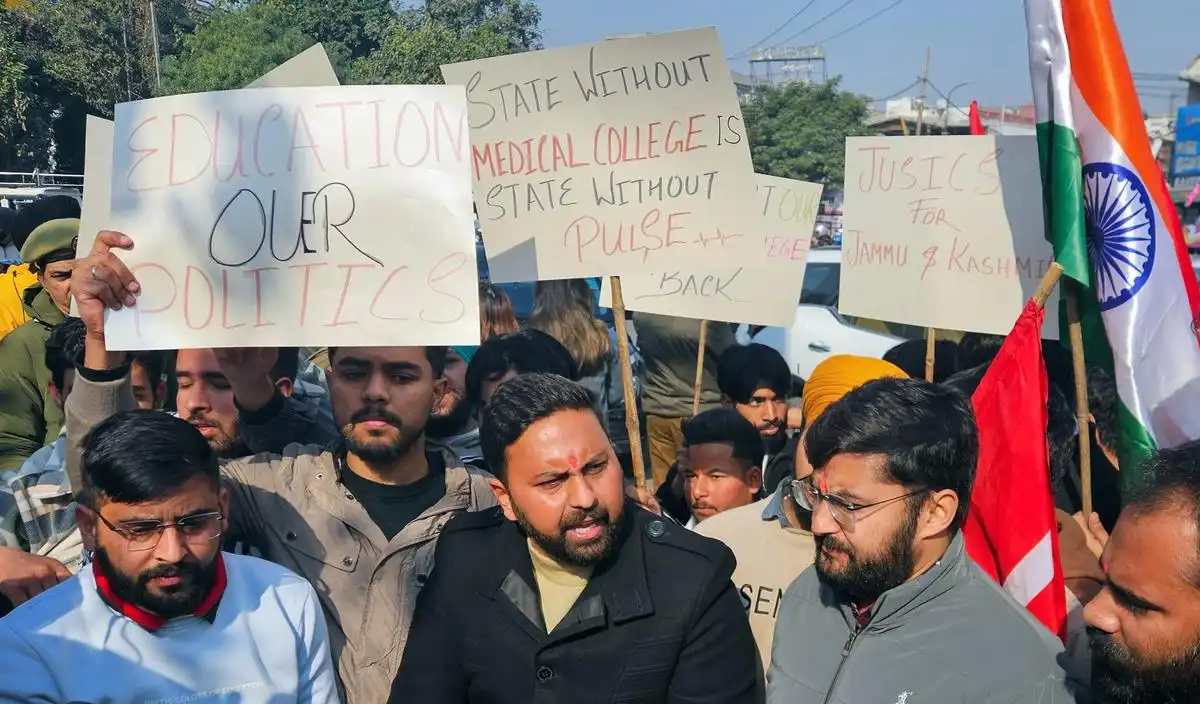
A storm erupted in Jammu and Kashmir after the newly established Shri Mata Vaishno Devi Institute of Medical Excellence revealed a first batch of students with 42 out of 50 seats filled by Muslim candidates through merit-based selection under the national medical entrance test (NEET). The college allocated 85% of seats to J&K domiciles, leading to only eight Hindu students gaining admission.
Hindu nationalist groups including the Vishwa Hindu Parishad (VHP) and Bajrang Dal protested, arguing that a shrine-funded institution should prioritise Hindus and even suggesting the college adopt “minority institution” status — a move that would legally allow religion-based admissions.
Political figures from the ruling party lodged formal complaints with the Lieutenant Governor’s office, demanding a review of admission norms and insisting that faith in the shrine’s presiding deity should influence seat allocation. Critics argued that such demands are tantamount to rewriting merit with religious preference — undermining constitutional secularism.
Jammu and Kashmir’s Chief Minister defended the merit list in blunt terms, noting that the Constitution clearly prohibits religion-based admissions and challenging detractors to seek legal remedy before the Supreme Court if they wish to discard merit in favour of creed-based criteria.
The episode triggered broader debate around secularism and educational equity, with observers warning that selective protest over admissions distorts meritocracy and fuels communal resentment, rather than constructive reform.
Birthday Party Assault: Moral Policing Goes Public
In a separate incident in Bareilly, Uttar Pradesh, members associated with a self-styled moral enforcement group stormed a private birthday party at a café, violently confronting guests and accusing two Muslim boys of “love jihad” — a widely discredited conspiracy theory alleging that Muslim men target Hindu women for conversion.
The party, organised by a nursing student and attended by classmates of mixed religious backgrounds, was interrupted when the vigilante group entered without invitation, hurled slogans, and physically assaulted two Muslim youths and others present. Despite the clear social nature of the event, the attackers invoked ideological suspicion rather than facts.
Surveillance video later circulated online showed the group pushing and hitting the students, even as the birthday girl pleaded with them to stop and clarified that it was a friendly gathering with no religious agenda. Police intervened and reportedly booked two Muslim boys and a café staffer for “breach of peace”, a twist that drew widespread criticism for appearing to penalise victims rather than protect them.
Local authorities clarified that the police inquiry found no evidence of love jihad or any criminal intent by the students in inviting their friends. Nonetheless, the case underscored how moral vigilantism can distort law enforcement and escalate ordinary social interactions into legal incidents with confusing outcomes.
Patterns of Moral Policing and Enforcement
These incidents are part of a broader pattern in which fringe groups with ideological motivations have increasingly intervened in matters ranging from private celebrations to educational admissions. Public advocates warn that such interventions, often backed by slogans and performative outrage, signal a disturbing trend where social control replaces social consent.
Experts note that the Constitution guarantees freedom of conscience, faith, and personal choice, and these freedoms extend into education and social life. Yet, when unauthorised actors assume the role of cultural gatekeepers — dictating whose presence is acceptable at a party or who deserves a merit-based seat — the result can be social estrangement and legal ambiguity.
Analysts further point out that disputes over admissions driven by religion — whether at a shrine-funded college or in elite institutions — divert attention from deeper issues like educational infrastructure, equitable access to coaching, and genuine welfare improvements. When ideological imperatives overshadow merit and equality, public trust in transparent systems can weaken.
Similarly, episodes of moral policing — from storming private parties to confrontations over food choices, clothing, or personal interactions — highlight the danger of substituting individual rights with collective suspicion. Critics argue that enforcing social norms with force celebrates obedience over understanding and fear over freedom.
Public Reaction and Legal Debate
Public reaction to both controversies has been sharply contested:
-
Supporters of the admissions protests argue that cultural identity and demographic representation should influence institutional priorities — a position that critics say conflates charity with constitutional secularism.
-
Opponents of moral policing underscore that when private social interactions are criminalised on the basis of identity, the space for personal freedom shrinks and the social fabric frays. Videos of the café attack were widely shared with comments such as “This is what happens when ideology replaces friendship” and “Two friends at a party should not end up in court for being friends.”
Legal experts emphasise that peaceful dissent is protected, but violence and intimidation — whether over admissions or personal gatherings — are prosecutable offences. They call for clarity in enforcement so that victims of vigilante behaviour are protected, and perpetrators are held accountable irrespective of ideological labels.
Conclusion: Culture, Law and Social Harmony
The college admissions row and the birthday party assault illustrate a growing fault line in public life where constitutional rights, cultural sentiments, and ideological enforcement intersect with contrasting interpretations of merit, morality and social order.
While cultural sentiments are significant in a diverse society, using force to enforce them — whether through mass protest over admissions or direct assault at a private event — raises profound questions about the rule of law and the boundaries of social governance.
As India continues to navigate these debates, observers stress that legal frameworks, constitutional protections, and lived social realities must align if freedom and harmony are to be more than aspirational slogans.
you may also like


- February 28, 2026
When Petty Theft Becomes a Public Image Problem

- February 28, 2026
Viral Influencer Scandal Shakes Chinese Social Media
- February 21, 2026
Pleasure Inequality in India: The Silent Gender Gap We Avoid Discussing

- February 17, 2026