Gujarat is expected to remain under the grip of intense monsoon activity for at least the next 24 hours as a stationary low-pressure system continues to fuel widespread rainfall, thunderstorms, and flood-like conditions across the state.
According to the India Meteorological Department (IMD), several parts of Gujarat could receive exceptionally heavy rainfall, with the weather system showing little sign of moving. The prolonged spell has heightened concerns over waterlogging, overflowing rivers, and localized flooding.
Why isn’t the low-pressure system moving?
Weather experts say the ongoing rainfall is being driven by a slow-moving low-pressure circulation that has become trapped due to weak steering winds in the middle levels of the atmosphere.
Typically, monsoon low-pressure systems move westward or northwestward, carrying rain to different regions. However, the current circulation has remained nearly stationary over Gujarat, allowing it to continuously pull moisture from the Arabian Sea.
This uninterrupted flow of moisture is creating repeated rounds of intense thunderstorms over the same locations, resulting in persistent heavy rainfall.
The situation is further strengthened by an active monsoon trough stretching across northern India, while warm Arabian Sea waters continue supplying abundant moisture to the weather system.
Repeated thunderstorms increasing flood risk
Meteorologists say the stationary weather pattern is producing what is commonly known as “training thunderstorms,” where multiple rain-bearing clouds move over the same area one after another.
This repetitive rainfall significantly increases the chances of flash floods, urban flooding, and waterlogging, especially in low-lying regions.
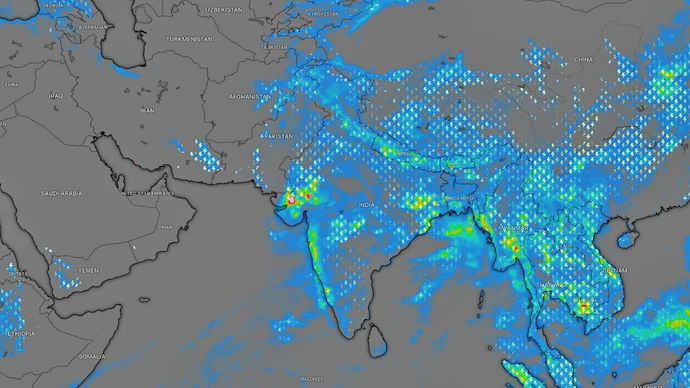
Satellite imagery has also shown a large mass of rain-bearing clouds covering Gujarat and the northeastern Arabian Sea, while weather radar continues to detect strong thunderstorm activity across the state.
IMD issues heavy rainfall warning
The IMD has forecast fairly widespread to widespread rainfall across Gujarat through July 28, with Saurashtra and Kutch expected to receive widespread showers until July 26.
Heavy to very heavy rainfall is likely across several districts between July 24 and July 27, while isolated areas could experience exceptionally heavy downpours during the early part of the forecast period.
Thunderstorms accompanied by lightning are also expected to continue across the state through July 27.
Monsoon activity to impact other regions
The active southwest monsoon is not limited to Gujarat. Heavy rainfall is also forecast over Konkan and Goa through July 30, while Madhya Maharashtra is expected to witness heavy to extremely heavy rain over the coming days.
With reservoirs filling rapidly and rivers already running high after continuous rainfall, authorities have advised residents, particularly those living in flood-prone and low-lying areas, to remain alert and follow official weather advisories.
Weather experts say Gujarat is likely to experience one of the season’s most persistent monsoon spells until the low-pressure system weakens or begins moving inland.
Key Highlights
- Gujarat is likely to receive heavy to exceptionally heavy rainfall for at least the next 24 hours.
- A stalled low-pressure system is preventing the monsoon from moving away from the state.
- Continuous moisture from the Arabian Sea is fueling repeated thunderstorms.
- IMD has warned of widespread rain, lightning, and possible flooding through July 27–28.
- Saurashtra and Kutch are expected to remain among the worst-affected regions.
- Heavy rainfall is also forecast for Konkan, Goa, and Madhya Maharashtra.
FAQs
Q1. Why is Gujarat receiving continuous heavy rainfall?
A stationary low-pressure system over western India is continuously drawing moisture from the Arabian Sea, resulting in prolonged rainfall and thunderstorms.
Q2. Why isn’t the low-pressure system moving?
Weak steering winds in the middle atmosphere have prevented the system from progressing, causing it to remain nearly stationary over Gujarat.
Q3. What are training thunderstorms?
Training thunderstorms occur when multiple rain clouds repeatedly move over the same area, leading to prolonged heavy rainfall and a higher risk of flooding.
Q4. How long will heavy rain continue in Gujarat?
The IMD has forecast widespread rainfall across Gujarat through July 28, with thunderstorms expected to continue until July 27.
Q5. Which regions are expected to receive the heaviest rainfall?
Several parts of Gujarat, including Saurashtra and Kutch, are likely to witness heavy to exceptionally heavy rainfall.
Q6. Which other states are expected to receive heavy monsoon rain?
Konkan and Goa, along with Madhya Maharashtra, are also expected to experience heavy to extremely heavy rainfall over the coming days.