

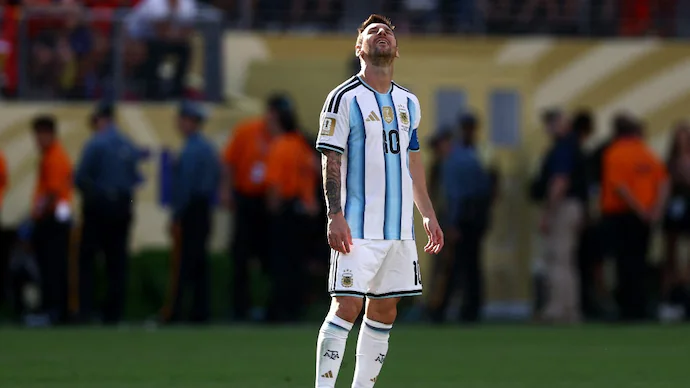
Spain produced one of the most disciplined performances of the FIFA World Cup 2026 by restricting Lionel Messi’s influence throughout the final against Argentina. Rather than assigning constant man-marking or relying on aggressive challenges, Spain controlled the match through tactical organisation, limiting the spaces where Messi has built his legendary career.
The approach paid off as Spain secured a 1-0 victory after extra time, lifting its second FIFA World Cup title.
Spain Focused on Controlling Space, Not Chasing Messi
Instead of surrounding Messi every time he received possession, Spain remained committed to its defensive structure.
Whenever the Argentine captain dropped into midfield to collect the ball, Spanish players maintained their positions, ensuring passing lanes into dangerous areas remained closed.
This forced Messi to receive possession much farther away from goal than usual, reducing his ability to create attacking opportunities.
Messi Was Forced Into Deeper Areas
Throughout the match, Messi frequently moved between midfield and attack searching for space.
However, Spain’s midfield consistently denied him room to turn and drive forward.
Rather than combining with Argentina’s attacking players near the penalty area, Messi spent much of the game recycling possession from deeper positions.
As a result, Argentina struggled to build sustained attacking pressure.
Match Statistics Reflect Spain’s Control
The final highlighted just how effectively Spain neutralised Argentina’s biggest attacking threat.
Messi finished the match with:
- 54 touches
- 40 successful passes from 53 attempts
- No chances created
- One shot, which came late in extra time
- Limited involvement in attacking sequences
Although he remained involved in Argentina’s build-up play, his influence in the final third was significantly reduced.
Spain’s Midfield Played a Crucial Role
Spain’s success was built on collective discipline rather than individual marking.
Rodri shielded the defence by protecting central spaces, while Pedri and Fabián Ruiz quickly closed down Messi whenever he received possession between the lines.
Young defender Pau Cubarsí also contributed by stepping forward when necessary before quickly recovering into position.
The coordinated movement prevented Argentina from creating combinations around Spain’s penalty area.
Possession Worked in Spain’s Favour
Spain also controlled the tempo through extended periods of possession.
By keeping the ball for long stretches, they reduced the number of opportunities Argentina had to involve Messi in dangerous attacks.
The strategy forced Argentina to spend much of the match chasing possession instead of dictating play.
Eventually, Spain’s patience was rewarded when Ferran Torres scored the decisive goal during extra time.
Messi’s World Cup Campaign Still Stands Out
Despite a quiet final, Messi remained one of the tournament’s standout performers.
His contributions throughout the competition helped Argentina reach another World Cup final, earning him the tournament’s Silver Ball for his overall performances.
While Spain successfully limited his impact on the biggest stage, his campaign once again demonstrated why he continues to rank among football’s greatest players.
Spain’s Tactical Discipline Made the Difference
The final showcased the importance of teamwork over individual battles.
Spain never abandoned its shape in pursuit of stopping Messi. Instead, every player fulfilled a clearly defined role, making it difficult for Argentina to find spaces throughout the match.
Their disciplined performance ultimately proved decisive in securing the world title.
Conclusion
Spain’s victory in the FIFA World Cup 2026 final was built on tactical intelligence, defensive organisation, and excellent ball control. Rather than attempting to stop Lionel Messi through aggressive marking, Spain simply denied him the areas where he is most dangerous. The result was one of the rare occasions when the Argentine legend struggled to influence a major final, allowing Spain to complete a memorable World Cup triumph.
Frequently Asked Questions (FAQs)
1. How did Spain stop Lionel Messi in the World Cup final?
Spain relied on disciplined positioning, controlled possession, and compact defending to deny Messi space instead of using constant man-marking.
2. How many shots did Lionel Messi have in the final?
Messi registered one shot, which came late in extra time.
3. Did Lionel Messi create any chances in the final?
No. He finished the match without creating a scoring opportunity.
4. Why was Messi forced to play deeper?
Spain blocked central attacking spaces, forcing him to collect possession farther from goal.
5. Which Spanish players played key defensive roles?
Rodri, Pedri, Fabián Ruiz, and Pau Cubarsí were among the players who helped restrict Messi’s influence.
6. Who scored the winning goal for Spain?
Ferran Torres scored the decisive goal during extra time.
7. Who won the FIFA World Cup 2026 final?
Spain defeated Argentina 1-0 after extra time to win the championship.
8. Did Messi win an individual award at the tournament?
Yes. Lionel Messi received the Silver Ball for his performances throughout the FIFA World Cup 2026.
9. Did Spain use man-marking against Messi?
No. Spain focused on maintaining its tactical structure rather than assigning a dedicated marker.
10. Why is Spain’s performance being praised?
Their organised defensive approach and control of possession effectively neutralised Argentina’s attack while helping secure the World Cup title.
Leave a Reply