

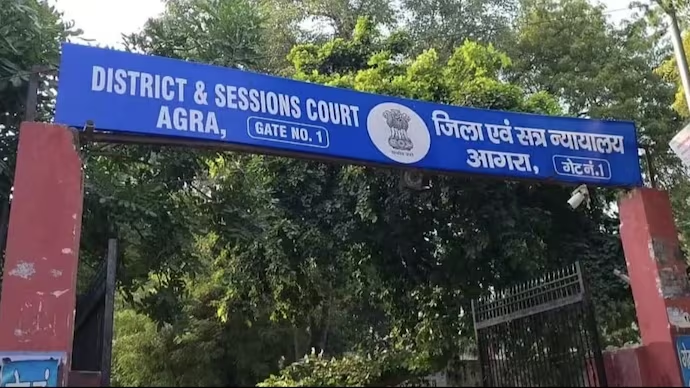
A court in Agra has sentenced a former police recruit to three years in prison for securing a job in the Provincial Armed Constabulary (PAC) by allegedly submitting a forged affidavit during the recruitment process. The verdict brings an end to a case that remained pending in the judicial system for nearly 27 years.
In addition to the prison sentence, the court imposed a fine of Rs 3,000. If the fine is not paid, the convict will have to undergo additional imprisonment as prescribed by the court.
Case Dates Back to the Late 1990s
The case originated during the 1998-99 PAC recruitment process.
According to the prosecution, Bhojraj, a resident of Hathras district, allegedly submitted a false affidavit while applying for the post of constable. During document verification, authorities reportedly identified discrepancies, leading to an investigation into the recruitment.
Following a complaint filed by a government official, a criminal case was registered at Tajganj Police Station in Agra on January 1, 1999.
Investigation Led to Chargesheet
Police completed their investigation and filed a chargesheet before the court on May 31, 1999.
The prosecution alleged that the accused had obtained government employment by using forged documents and providing false information during the recruitment process.
The matter then proceeded through the legal system, where it remained pending for more than two decades before reaching its conclusion.
Court Found Accused Guilty
Evidence Examined During Trial
The case was heard in the court of the Special Chief Judicial Magistrate in Agra.
During the trial, the prosecution presented documentary evidence and witness testimonies to support its allegations. After considering the evidence and hearing arguments from both sides, the court held the accused guilty of cheating and using forged documents to obtain government employment.
The court subsequently sentenced Bhojraj to three years of imprisonment and imposed a monetary penalty.
Recruitment Fraud Under Judicial Scrutiny
The verdict highlights the importance of document verification in government recruitment processes.
Authorities routinely examine educational certificates, identity records and affidavits submitted by candidates to ensure that appointments are made based on authentic information. Cases involving forged documents can result in criminal prosecution, cancellation of employment and imprisonment if guilt is established by the courts.
Why the Verdict Matters
Although the alleged offence dates back to the late 1990s, the judgment demonstrates that recruitment-related fraud cases can continue through the judicial process for many years before reaching a final decision.
The ruling also underscores the legal consequences of submitting false information or forged documents while applying for government jobs.
Conclusion
The Agra court’s decision closes a recruitment fraud case that remained in the legal system for nearly 27 years. By convicting the former police recruit and imposing a prison sentence, the court reaffirmed the importance of integrity in public recruitment and the legal consequences of obtaining government employment through fraudulent means.
FAQs
1. What is the Agra police recruitment fraud case?
The case involves a former police recruit who was convicted of obtaining a government job by allegedly submitting a forged affidavit during the PAC recruitment process.
2. Who was convicted in the case?
A court found Bhojraj, a resident of Hathras district, guilty of cheating and using forged documents to secure government employment.
3. What sentence did the court impose?
The court sentenced the convict to three years in prison and imposed a fine of Rs 3,000.
4. Why did the case take 27 years?
The matter remained pending in the judicial system after the investigation and trial process, ultimately reaching its conclusion nearly 27 years after the alleged offence.
5. What was the allegation against the accused?
The prosecution alleged that the accused submitted a false affidavit during the recruitment process to obtain a constable’s position in the Provincial Armed Constabulary (PAC).
6. When was the case registered?
The criminal case was registered on January 1, 1999, following a complaint related to document verification during recruitment.
7. What is the Provincial Armed Constabulary (PAC)?
The Provincial Armed Constabulary is a specialized armed police force in Uttar Pradesh that assists in maintaining law and order and supporting security operations.
8. What happens if someone submits forged documents for a government job?
Submitting forged documents can lead to cancellation of employment, criminal prosecution and imprisonment if the allegations are proven in court.
9. Was the accused’s guilt established by the court?
Yes. After examining witness testimonies and documentary evidence, the court convicted the accused and awarded the sentence.
10. Why is document verification important in government recruitment?
Document verification helps ensure that only eligible candidates receive public employment and protects the integrity and fairness of the recruitment process.
Leave a Reply