

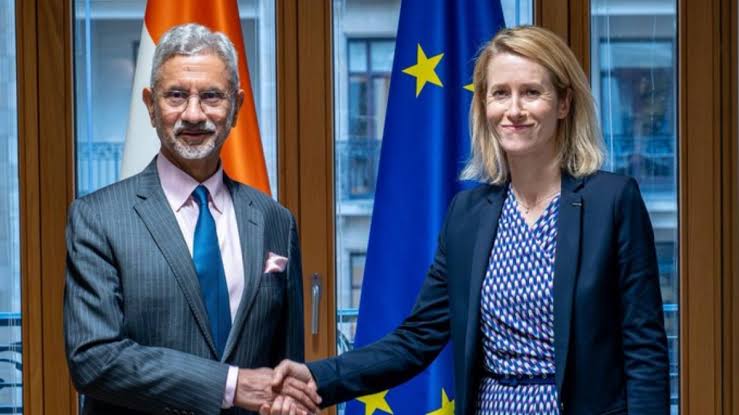
India and the European Union have reaffirmed their commitment to expanding cooperation across trade, technology, security and investment following a series of high-level meetings in Brussels. External Affairs Minister S. Jaishankar said the partnership has made notable progress since the India-EU Summit held earlier this year, with both sides now focusing on strengthening strategic collaboration in an increasingly uncertain global environment.
The discussions highlighted shared priorities including resilient supply chains, maritime security, digital cooperation and deeper economic engagement, reflecting the growing importance of India-EU ties.
India and EU review progress in strategic partnership
During his two-day visit to Belgium, Jaishankar met European Council President Antonio Costa and European Commission Vice President Kaja Kallas to assess the progress made since the recent India-EU Summit.
The meetings focused on advancing cooperation in key sectors such as trade, emerging technologies, defence, maritime commerce and global supply chains.
Jaishankar said the discussions reflected the steady growth of the India-EU partnership and the commitment from both sides to expand cooperation further in the coming years.
Trade and Technology Council remains a major priority
The visit also included participation in the third India-EU Trade and Technology Council meeting.
The council has emerged as one of the most important platforms for strengthening collaboration in digital innovation, advanced technologies, clean energy, semiconductors, artificial intelligence and secure supply chains.
Commerce and Industry Minister Piyush Goyal and Minister of State Jitin Prasada joined Jaishankar during the engagements, underlining India’s whole-of-government approach toward enhancing relations with the European Union.
Maritime security takes centre stage
One of the major topics discussed during the meetings was maritime security and ensuring uninterrupted global trade routes.
Both India and the EU stressed the importance of protecting freedom of navigation and maintaining safe maritime commerce, particularly amid rising geopolitical tensions affecting international shipping.
The leaders also exchanged views on expanding cooperation between European naval missions and the Indian Navy to strengthen security across the Indo-Pacific region.
Focus on resilient supply chains and global stability
Supply chain resilience remained another major focus of the Brussels discussions.
India and the EU agreed on the importance of building reliable and diversified supply networks that can withstand future global disruptions.
The leaders also discussed regional security developments, including the situation in West Asia, and emphasized the need to promote peace, stability and uninterrupted international trade.
Belgium seen as an important economic partner
Apart from meetings with EU officials, Jaishankar also held discussions with leaders from Belgium’s Flanders region.
The talks explored opportunities to increase business partnerships, investments and industrial cooperation following stronger economic engagement between India and the European Union.
Officials highlighted that the growing trade relationship creates fresh opportunities for companies on both sides in manufacturing, logistics, technology and innovation.
India-EU ties have strengthened in 2026
Relations between India and the European Union have witnessed significant momentum this year.
The India-EU Summit earlier in 2026 expanded cooperation across trade, defence, technology and strategic affairs, laying the foundation for closer long-term engagement.
Since then, both sides have accelerated discussions on implementing economic agreements, boosting innovation partnerships and enhancing collaboration in areas critical to global security.
What comes next?
The Brussels meetings indicate that India and the European Union intend to deepen cooperation beyond traditional trade ties. With greater emphasis on technology, maritime security, resilient supply chains and investment, both partners are positioning themselves for broader strategic collaboration. The outcomes of the Trade and Technology Council discussions and future implementation of joint initiatives will be closely watched in the months ahead.
FAQs
1. Why did S. Jaishankar visit Brussels?
S. Jaishankar visited Brussels to participate in the third India-EU Trade and Technology Council (TTC) meeting and hold discussions with senior European Union and Belgian leaders on trade, technology, security and strategic cooperation.
2. What were the main issues discussed during the India-EU meetings?
The talks focused on trade, technology, maritime security, resilient supply chains, investment opportunities, regional stability, digital cooperation and strengthening the overall India-EU strategic partnership.
3. What is the India-EU Trade and Technology Council?
The India-EU Trade and Technology Council is a high-level platform that promotes cooperation in areas such as digital technologies, artificial intelligence, semiconductors, clean energy, innovation, cybersecurity and resilient supply chains.
4. Who did Jaishankar meet during his Brussels visit?
During the visit, Jaishankar met European Council President Antonio Costa, European Commission Vice President Kaja Kallas and leaders from Belgium’s Flanders region, along with participating in meetings with EU counterparts.
5. Why is maritime security important in India-EU relations?
Both India and the European Union consider secure maritime routes essential for global trade. They aim to work together to ensure freedom of navigation and protect international shipping lanes, especially in the Indo-Pacific region.
6. What role does Belgium play in India-EU cooperation?
Belgium serves as an important trade and investment partner for India. Discussions during the visit explored new opportunities for businesses, manufacturing, logistics, technology and industrial collaboration.
7. What is meant by resilient supply chains?
Resilient supply chains are networks that can continue operating during global disruptions such as conflicts, pandemics or economic crises. India and the EU are working to make supply chains more reliable and diversified.
8. How have India-EU relations evolved in 2026?
India and the European Union have expanded cooperation across trade, defence, technology, investment and security following the India-EU Summit earlier this year, with both sides pursuing closer strategic engagement.
9. Which Indian ministers accompanied Jaishankar to Brussels?
Union Commerce and Industry Minister Piyush Goyal and Minister of State Jitin Prasada accompanied Jaishankar during the visit and participated in the Trade and Technology Council meetings.
10. What can be expected after the Brussels talks?
The discussions are expected to accelerate cooperation on trade agreements, technology partnerships, maritime security, supply chain resilience and investment, further strengthening the long-term India-EU strategic relationship.
Leave a Reply