

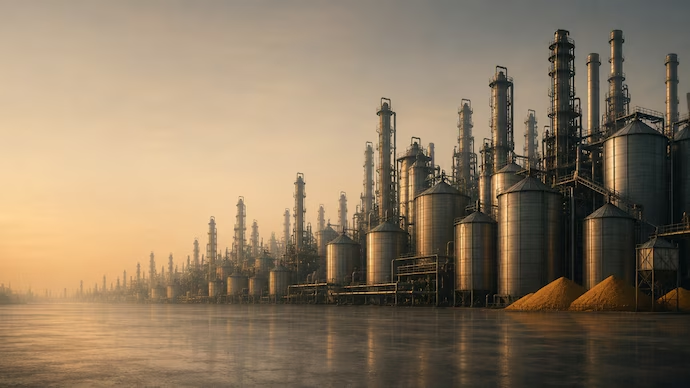
India’s rapid push towards cleaner fuels has achieved one of its biggest energy milestones ahead of schedule. The country has successfully reached its E20 petrol blending target—five years before the original deadline. While this marks a major policy success, it has also created a new challenge: ethanol production capacity now exceeds current domestic demand.
Industry estimates suggest India has developed nearly 2,000 crore litres of annual ethanol production capacity, while current consumption requirements stand at around 1,300 crore litres, leaving a notional surplus capacity of nearly 700 crore litres.
The situation does not mean India is sitting on massive unsold ethanol stocks. Instead, it indicates that the country has built infrastructure capable of producing significantly more ethanol than the market currently requires.
India Achieved E20 Target Years Ahead of Schedule
India introduced ethanol blending to reduce dependence on imported crude oil, lower carbon emissions, and create an additional income source for farmers.
The Ethanol Blended Petrol (EBP) Programme began with small pilot projects in 2001 before expanding rapidly over the past decade through policy support, financial incentives, and procurement commitments from public sector oil marketing companies.
The government achieved 20% ethanol blending (E20) during the 2025-26 Ethanol Supply Year, advancing the original 2030 target by five years.
According to official estimates, the programme has:
- Reduced crude oil imports substantially
- Saved significant foreign exchange
- Increased farmer incomes through higher demand for sugarcane and grains
- Lowered carbon emissions from transportation
Massive Investments Expanded Ethanol Production
To meet ambitious blending targets, India witnessed one of the fastest expansions of ethanol manufacturing infrastructure.
Industry data shows around 370 ethanol distilleries are currently operational, while nearly 40 additional facilities are under construction.
Installed production capacity has grown from roughly 421 crore litres in 2014 to nearly 2,000 crore litres in 2026.
Banks financed large-scale investments in new distilleries, storage facilities, transport networks, and supporting infrastructure, while oil companies signed long-term procurement agreements to encourage private investment.
Why Is There a 700 Crore Litre Surplus Capacity?
The surplus refers to production capability rather than unused ethanol inventory.
India currently requires approximately:
- Around 1,200 crore litres annually for petrol blending
- Additional quantities for industrial uses, including pharmaceuticals, chemicals, and beverages
Against these requirements, installed capacity exceeds demand by roughly 700 crore litres.
This creates a situation where many ethanol plants may operate below optimal capacity if domestic demand does not increase steadily over the coming years.
Lower plant utilisation can affect profitability, loan repayments, and returns on investments made during the industry’s rapid expansion phase.
Export Markets Could Help Absorb Excess Capacity
Industry representatives believe exports could become an important short-term solution.
Countries such as Nepal, Bangladesh, and Indonesia are gradually expanding ethanol blending programmes but currently lack sufficient domestic production capacity.
Exporting ethanol to these markets could help Indian distilleries utilise idle production capacity until domestic consumption catches up.
The industry also expects future demand to increase as more flex-fuel-compatible vehicles enter Indian roads.
Grain-Based Ethanol Now Dominates Production
India’s ethanol programme initially relied heavily on sugarcane-based feedstocks.
However, the industry has undergone a significant shift.
Grain-based ethanol now accounts for nearly two-thirds of total supplies, reducing dependence on sugar production alone.
Major feedstocks currently include:
- Maize
- Broken rice supplied by the Food Corporation of India
- Sugarcane juice
- B-heavy molasses
- Damaged food grains
Diversifying raw materials has improved supply stability and reduced risks associated with poor harvests of any single crop.
Challenges Still Remain
Despite the impressive capacity expansion, several concerns continue to surround India’s ethanol programme.
Experts point to issues such as:
- Lower fuel efficiency reported by some motorists using E20 petrol
- Compatibility concerns for older vehicles
- High water consumption associated with sugarcane cultivation
- Potential pressure on food grain supplies during poor harvest years
- Slower growth in ethanol demand compared to manufacturing capacity
Industry stakeholders believe the focus must now shift from expanding production capacity to improving utilisation and ensuring long-term financial sustainability.
Why India Is Not Returning to E10 Fuel
Some experts have suggested maintaining both E10 and E20 petrol to allow a more gradual transition.
However, the government argues that operating two nationwide fuel grades would require separate storage, transportation, and dispensing infrastructure across more than one lakh fuel stations.
Officials also note that nearly Rs 1 lakh crore has already been invested in ethanol plants, logistics, and storage infrastructure, making a rollback financially difficult.
Instead, policymakers are expected to focus on increasing ethanol demand over time through wider adoption of compatible vehicles and possible future expansion beyond E20.
What Lies Ahead for India’s Ethanol Industry?
India’s ethanol programme has successfully created one of the world’s largest biofuel production ecosystems.
While current capacity exceeds domestic demand, the surplus also provides room for future growth without requiring another round of large infrastructure investments.
The next phase will depend on how effectively India expands ethanol consumption, develops export markets, and balances energy security goals with concerns related to agriculture, water use, and vehicle compatibility.
For ethanol producers, the priority will be maintaining healthy plant utilisation rates. For policymakers, the challenge will be ensuring that the massive investments made during the country’s biofuel expansion continue delivering economic and environmental benefits in the years ahead.
Frequently Asked Questions (FAQs)
1. Why does India have surplus ethanol production capacity?
India rapidly expanded production to meet its E20 blending target ahead of schedule, resulting in installed capacity exceeding current demand.
2. How much surplus ethanol capacity does India have?
Industry estimates suggest a notional surplus production capacity of approximately 700 crore litres annually.
3. Is India producing excess ethanol right now?
No. The surplus refers to production capacity, not unsold ethanol inventories.
4. Why did India promote ethanol blending?
The programme aims to reduce crude oil imports, improve energy security, lower emissions, and increase farmers’ income.
5. What is E20 petrol?
E20 petrol contains 20% ethanol and 80% petrol by volume.
6. Can surplus ethanol be exported?
Yes. Industry bodies are exploring export opportunities in countries including Nepal, Bangladesh, and Indonesia.
7. What are India’s main ethanol feedstocks?
Maize, broken rice, sugarcane juice, molasses, damaged food grains, and other agricultural biomass.
8. Will India move beyond E20 blending?
The government has indicated interest in exploring higher blends in the future, though widespread adoption would require more compatible vehicles.
9. Why can’t India switch back to E10 petrol?
Officials say maintaining multiple fuel grades nationwide would increase logistics costs and undermine large investments already made in ethanol infrastructure.
10. What is the biggest challenge for India’s ethanol industry now?
The primary challenge is increasing demand fast enough to utilise the country’s expanded production capacity while ensuring investments remain financially viable.
Leave a Reply