

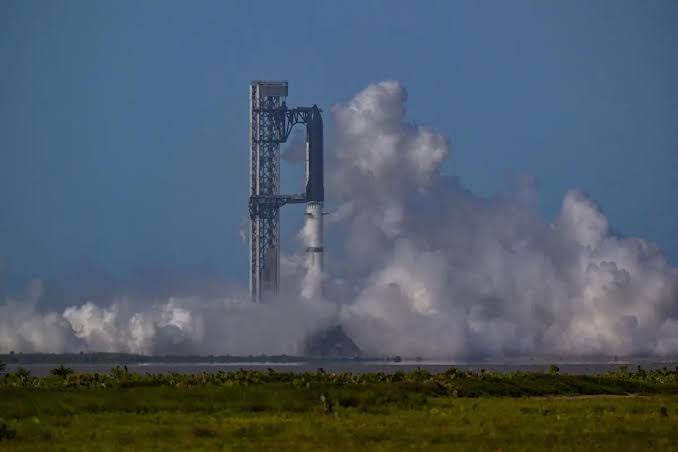
SpaceX was forced to abort the 13th test flight of its Starship rocket just seconds before liftoff after multiple engines failed to ignite properly, delaying another crucial milestone for the world’s most powerful launch vehicle.
The mission was expected to carry 20 next-generation Starlink satellites while gathering important flight data for SpaceX’s future Mars ambitions and NASA’s Artemis Moon programme. Instead, the rocket remained on the launch pad after a partial engine ignition triggered an automatic shutdown.
Launch Stopped Just Before Liftoff
The countdown progressed normally until approximately three seconds before launch, when Starship’s engines began igniting.
However, several engines failed to start correctly. The engines that had ignited quickly shut down, preventing the rocket from leaving the launch pad.
Following the automatic abort, SpaceX teams immediately began draining propellant from the vehicle while engineers started reviewing the issue.
Elon Musk Hopes for Quick Retry
SpaceX CEO Elon Musk addressed the failed attempt shortly after the launch.
He said the company hopes to make another launch attempt within the next few days, depending on the outcome of technical inspections and investigations into the engine issue.
Engineers will now determine what caused the ignition failure before giving Starship clearance for another test.
Mission Included 20 New Starlink Satellites
The test flight was expected to deploy 20 upgraded Starlink internet satellites during a planned suborbital mission.
The satellites were also scheduled to perform communication tests with the existing Starlink constellation while capturing images of Starship’s heat shield during flight.
Neither the Super Heavy booster nor the Starship spacecraft was intended to return to the launch site. Both stages were expected to complete controlled splashdowns in the ocean after completing the mission.
NASA’s Moon Plans Closely Linked to Starship
The delay also affects NASA’s long-term Artemis programme.
NASA has selected Starship as one of the lunar landing systems for future Moon missions. The spacecraft is expected to transport astronauts from lunar orbit to the Moon’s surface during upcoming Artemis missions.
Before astronauts can use Starship, SpaceX must complete a series of successful test flights demonstrating the rocket’s reliability and landing capabilities.
Starship Plays Key Role in Future Space Missions
Starship remains central to SpaceX’s long-term vision of reusable deep-space transportation.
Beyond supporting NASA’s lunar programme, the fully reusable rocket is designed to carry large satellite payloads, support future Mars missions and significantly reduce launch costs.
Every test flight provides valuable engineering data, even when missions end early.
Investigation Underway Before Next Launch
SpaceX has not yet announced the exact cause of the failed engine ignition.
The company is expected to complete technical inspections before confirming a revised launch schedule.
If engineers resolve the issue quickly, another Starship test flight could take place within days.
Why This Test Flight Was Important
The aborted launch was expected to advance multiple SpaceX objectives simultaneously, including:
- Testing Starship’s upgraded systems
- Deploying 20 new Starlink satellites
- Collecting heat shield performance data
- Supporting NASA’s Artemis Moon mission timeline
- Validating hardware for future deep-space missions
Although the launch was called off safely, the delay highlights the technical challenges involved in developing the world’s largest reusable rocket.
FAQs
Why was the Starship launch aborted?
The launch was automatically stopped after several engines failed to ignite properly during the final seconds of the countdown.
Did Starship lift off?
No. The rocket remained on the launch pad after the automatic shutdown.
How many Starlink satellites were onboard?
The mission was carrying 20 next-generation Starlink satellites.
What did Elon Musk say after the launch?
He said SpaceX hopes to attempt another launch within a few days after investigating the issue.
Will NASA’s Artemis programme be affected?
The delay could impact testing timelines, but NASA and SpaceX continue working toward future Moon missions.
Was anyone injured?
No injuries were reported, and the launch abort system worked as intended.
What is Starship designed for?
Starship is designed for satellite launches, Moon missions, Mars exploration and fully reusable space transportation.
Will SpaceX attempt another launch soon?
Yes. The company expects another launch attempt after completing technical checks and resolving the engine issue.
Leave a Reply