

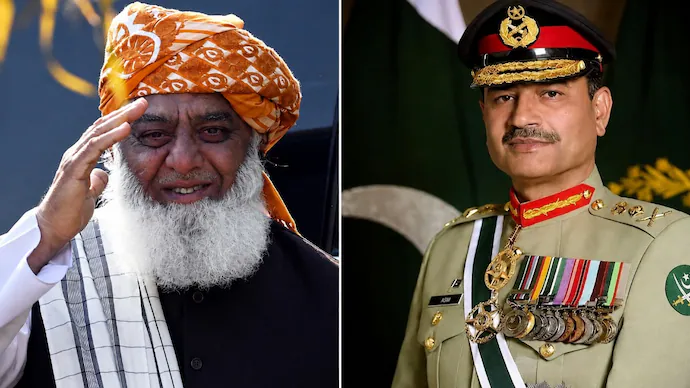
Pakistan’s political landscape has witnessed a fresh confrontation after senior Islamist leader Maulana Fazlur Rehman openly challenged the country’s military leadership, urging Field Marshal Asim Munir to leave the army and contest elections if he wishes to influence politics.
The Jamiat Ulema-e-Islam-Fazl (JUI-F) chief questioned the military’s growing role in Pakistan’s political affairs, saying public support should be tested through democratic elections rather than military authority.
Who is Maulana Fazlur Rehman?
Born on June 19, 1953, in Dera Ismail Khan, Fazlur Rehman is the son of prominent Islamic scholar and politician Mufti Mahmud, who served as Chief Minister of the former North-West Frontier Province.
Following his father’s death in 1980, Rehman assumed leadership of the Jamiat Ulema-e-Islam. The party later split into two factions, with Rehman leading the JUI-F. Over the decades, he has become one of Pakistan’s most influential religious and political figures, winning multiple terms in the National Assembly.
His political influence remains strongest in Khyber Pakhtunkhwa and Balochistan, where the party enjoys strong grassroots support through an extensive network of religious institutions.
Long-standing Support for the Taliban
Fazlur Rehman has consistently backed the Afghan Taliban and has advocated closer relations between Pakistan and Afghanistan’s Taliban-led government.
He opposed Pakistan’s support for the US-led intervention in Afghanistan after 2001 and has repeatedly urged the international community to recognise the Taliban administration following its return to power in 2021.
The veteran cleric has also promoted wider implementation of Sharia law in Pakistan, while maintaining that legal and political means—not armed violence—should be used to achieve Islamic governance.
From Political Ally to Military Critic
Although Rehman now openly criticises Pakistan’s military establishment, he previously played an important role in the opposition alliance that removed former Prime Minister Imran Khan from power through a no-confidence vote in 2022.
The political developments that followed eventually paved the way for Asim Munir to become Pakistan’s Army Chief. However, relations between Rehman and the ruling establishment later deteriorated as disagreements emerged over governance and military influence.
In recent months, Rehman has intensified his criticism of the military’s role in politics and its handling of security issues, including the situation in Balochistan and tensions with Afghanistan.
Direct Challenge to Asim Munir
Speaking at a public gathering, Rehman questioned the military’s involvement in political matters, arguing that elected representatives—not the armed forces—should determine Pakistan’s future.
He challenged Asim Munir to resign from the military and seek public support through elections if he wishes to participate in politics.
His remarks have drawn widespread attention, as direct criticism of Pakistan’s powerful military leadership by senior political figures remains relatively uncommon.
Political Significance
Rehman’s latest statements underline growing political tensions within Pakistan, where debates over the military’s role in governance continue to shape national politics.
While it remains unclear how the military establishment will respond, the comments have positioned Fazlur Rehman as one of the most outspoken civilian voices challenging the country’s powerful security leadership.
FAQs
1. Who is Maulana Fazlur Rehman?
Maulana Fazlur Rehman is the chief of Pakistan’s Jamiat Ulema-e-Islam-Fazl (JUI-F) and one of the country’s most influential Islamist politicians.
2. Why is Fazlur Rehman in the news?
He has publicly challenged Pakistan’s military chief Asim Munir, urging him to leave the army and contest elections if he wants to play a political role.
3. What is JUI-F?
JUI-F is an Islamist political party in Pakistan with strong support in Khyber Pakhtunkhwa and Balochistan.
4. Is Fazlur Rehman associated with the Taliban?
He has long supported the Afghan Taliban politically and has advocated closer ties between Pakistan and Afghanistan’s Taliban-led government.
5. What is his stance on Sharia law?
Rehman supports greater implementation of Sharia law in Pakistan through political and constitutional means.
6. What did he say about Asim Munir?
He said Asim Munir should remove his military uniform and contest elections if he wishes to participate in politics.
7. What role did Rehman play in Imran Khan’s removal?
He helped lead the opposition alliance that successfully removed Imran Khan through a parliamentary no-confidence vote in 2022.
8. Why are his comments significant?
Open criticism of Pakistan’s military leadership by senior politicians is uncommon, making his remarks politically important.
Leave a Reply