

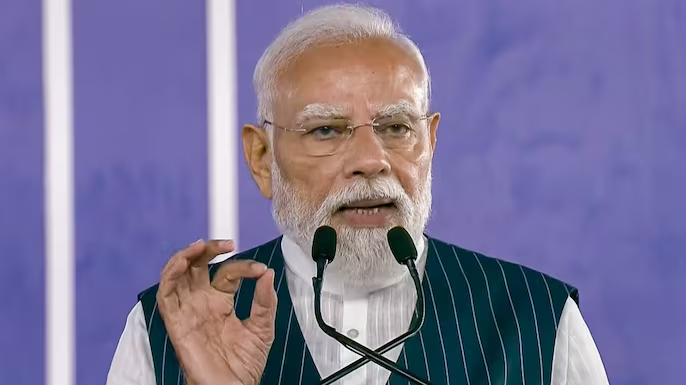
Prime Minister Narendra Modi flagged off India’s first hydrogen-powered train from Jind Railway Station in Haryana on Friday, marking a significant milestone in the country’s push towards clean and sustainable transportation.
The hydrogen fuel cell train will operate on the Jind–Sonipat route and is expected to strengthen India’s efforts to promote green mobility while reducing dependence on fossil fuels.
India enters hydrogen-powered rail era
The launch of the country’s first hydrogen train represents a major advancement in Indian Railways’ clean energy initiatives.
Unlike conventional diesel-powered trains, the hydrogen-powered train runs on hydrogen fuel cell technology, producing only water vapour as its emission. The environmentally friendly system also eliminates the need for overhead electrification and helps reduce noise pollution.
Officials said the project has been designed, engineered and integrated in India using indigenous technology.
Key features of India’s first hydrogen train
The newly launched hydrogen-powered train comes with several advanced features designed to improve efficiency and passenger comfort.
Some of its key specifications include:
- 10-coach hydrogen fuel cell trainset
- 1,200 kW hydrogen fuel cell propulsion system
- 3,200 HP propulsion across the train
- Approved operating speed of 75 kmph
- Design speed of 110 kmph
- Passenger capacity of around 2,600
- Zero carbon emissions, with only water vapour released during operation
The project is part of Indian Railways’ broader strategy to adopt cleaner and more sustainable transport technologies.
Train to connect Jind and Sonipat
The hydrogen-powered train will operate on the 89-kilometre Jind–Sonipat section in Haryana.
Apart from connecting Jind Junction, Gohana Junction, and Sonipat, the train will serve several intermediate stations, improving regional rail connectivity.
The proposed halts include:
- Jind City
- Pandu Pindara Junction
- Lalit Khera Halt
- Bhambhewa
- Isapur Kheri Halt
- Butana Halt
- Khandrai Halt
- Rabrah Halt
- Lath Halt
- Mohana
- Barwasni Halt
- Sonipat New
Railway Minister reviewed preparations before launch
Ahead of the inauguration, Union Railway Minister Ashwini Vaishnaw visited Jind Railway Station to review operational preparations.
The minister interacted with railway officials and loco pilots to assess the readiness of the country’s first hydrogen-powered rail service before its inaugural run.
The launch marks another step in Indian Railways’ modernisation programme and clean energy transition.
PM Modi to inaugurate multiple development projects
Following the train inauguration, the Prime Minister is scheduled to inaugurate and lay the foundation stone for several development projects at Eklavya Stadium in Jind.
Later in the day, he will travel to Chandigarh to launch additional infrastructure projects before heading to Jalandhar, Punjab, where he is expected to inaugurate more projects and address a public gathering.
The multi-state visit focuses on infrastructure development, railway modernisation and public welfare initiatives.
Hydrogen train expected to boost green mobility
Hydrogen-powered trains are considered one of the most promising alternatives to diesel-powered rail transport because they generate virtually no harmful emissions.
The introduction of the new train is expected to support India’s environmental goals while demonstrating the country’s growing capabilities in developing advanced railway technologies.
Officials believe the project could pave the way for wider adoption of hydrogen-powered rail services across non-electrified railway routes in the future.
Frequently Asked Questions (FAQs)
1. Who flagged off India’s first hydrogen-powered train?
Prime Minister Narendra Modi inaugurated the country’s first hydrogen-powered train.
2. Where was the hydrogen train launched?
The train was flagged off from Jind Railway Station in Haryana.
3. Which route will the hydrogen train operate on?
It will run on the Jind–Sonipat route in Haryana.
4. What powers the hydrogen train?
The train uses a hydrogen fuel cell propulsion system.
5. What is the passenger capacity of the train?
The train can accommodate approximately 2,600 passengers.
6. What is the maximum operating speed?
The approved operating speed is 75 kmph, while the design speed is 110 kmph.
7. Does the hydrogen train produce pollution?
No. The train’s only direct emission is water vapour, making it an environmentally friendly mode of transport.
8. Was the train developed in India?
Yes. The hydrogen-powered train was designed, engineered and integrated using indigenous technology.
9. What projects is PM Modi launching during his visit?
Apart from the hydrogen train, the Prime Minister is inaugurating and laying foundation stones for several infrastructure and development projects in Haryana, Chandigarh and Punjab.
10. Why is the hydrogen train important?
It marks India’s entry into hydrogen-powered rail transport and supports the country’s efforts to promote sustainable, clean-energy public transportation.
Leave a Reply