

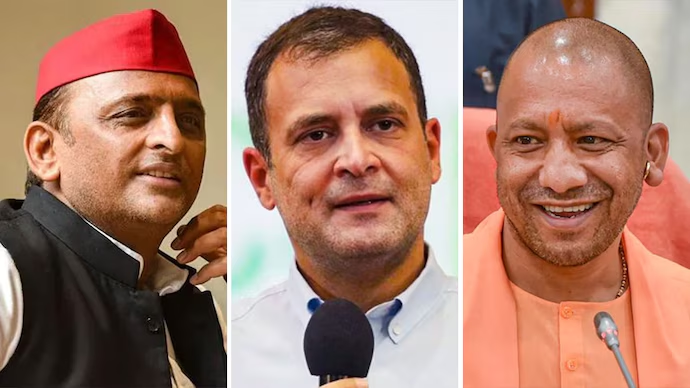
With the 2027 Uttar Pradesh Assembly elections drawing closer, political messaging across the state is increasingly revolving around Sanatan Dharma, the Ram Mandir and religious identity. What began as a debate over the alleged Ram Mandir donation controversy has now evolved into a wider political contest over faith, governance and public perception.
The issue has provided fresh momentum to political campaigns, with both the Bharatiya Janata Party (BJP) and opposition parties seeking to shape the narrative in their favour. Political analysts believe the focus is no longer on whether religion will influence the election, but on which party can connect most effectively with voters through that narrative.
Ram Mandir Donation Issue Becomes a Political Flashpoint
The alleged controversy surrounding donations to the Ayodhya Ram Mandir has emerged as one of the most discussed political issues in Uttar Pradesh.
Opposition parties, including the Congress and the Samajwadi Party (SP), have questioned the handling of temple donations, describing the matter as one of accountability and transparency rather than religious belief.
While criticising the alleged financial irregularities, both parties have simultaneously kept the Ram Mandir at the centre of their campaign messaging, further reinforcing the temple’s political significance ahead of the elections.
BJP Continues to Build Campaign Around Hindutva and Development
The BJP has maintained that its governance model combines development initiatives with cultural and religious priorities.
Over the past decade, the party has consistently highlighted landmark projects such as:
- Construction of the Ram Mandir in Ayodhya
- Redevelopment of the Kashi Vishwanath Corridor
- Infrastructure expansion in Ayodhya
- Promotion of religious tourism across Uttar Pradesh
Party leaders argue that these initiatives reflect their long-standing commitment to preserving India’s cultural heritage while pursuing economic development.
Yogi Adityanath Targets Opposition Over Ram Mandir Politics
Chief Minister Yogi Adityanath has strongly responded to the Opposition’s criticism by recalling its historical stance on the Ram Janmabhoomi movement.
He has accused rival parties of previously opposing Hindu religious initiatives while defending the government’s handling of the alleged Ram Mandir donation issue. According to the BJP, authorities initiated action after receiving the findings of the investigation.
The party has also attempted to shift the debate beyond the donation controversy by highlighting its decades-long association with the Ram Mandir movement and the fulfillment of its political commitments.
Samajwadi Party Expands Religious Outreach
The Samajwadi Party, led by Akhilesh Yadav, has noticeably increased the use of religious symbolism in its political strategy.
Recent initiatives associated with the party include:
- Public references to Lord Hanuman and Hindu traditions
- Participation in religious programmes
- Preparations for the Samajwadi PDA Rath Yatra
- Plans to inaugurate the Kedareshwar Mahadev Temple in Etawah
Political observers believe these efforts are aimed at expanding the party’s support among Hindu voters while maintaining its traditional social coalition.
Congress Repositions Its Public Image
The Congress has also adjusted its messaging ahead of the Assembly elections.
Party leaders have publicly described themselves as followers of Sanatan traditions while maintaining that raising concerns about alleged temple donation irregularities should not be viewed as opposition to religious beliefs.
The party has attempted to present accountability and faith as complementary issues, arguing that public scrutiny of financial matters should not be interpreted as criticism of religious institutions.
Religion and Governance Shape the Election Narrative
Experts believe Uttar Pradesh’s political landscape has entered a phase where nearly every major political party is engaging with issues related to religion and cultural identity.
While the BJP continues to emphasise its historical role in the Ram Janmabhoomi movement and Hindu cultural issues, opposition parties are trying to combine discussions on governance, transparency and social justice with expressions of religious faith.
This convergence suggests that the 2027 Assembly election could witness one of the strongest contests over ideological positioning in recent years.
Political Narrative Expected to Intensify
As campaigning gradually gains momentum, debates surrounding the Ram Mandir, Sanatan Dharma and religious identity are expected to remain central to Uttar Pradesh’s political discourse.
Whether the focus stays on governance, transparency or cultural identity, analysts believe the election battle will increasingly revolve around which political party succeeds in defining the broader narrative for voters.
Frequently Asked Questions (FAQs)
1. Why has the Ram Mandir issue become important before the 2027 UP elections?
The alleged donation controversy has become a major political issue, with opposition parties raising questions about accountability while the BJP highlights its role in the Ram Mandir movement.
2. How is the Samajwadi Party changing its campaign strategy?
The party has increased its focus on religious outreach through temple visits, religious symbolism and the proposed PDA Rath Yatra alongside its traditional political agenda.
3. What is the Congress saying about the controversy?
Congress leaders maintain that questioning alleged financial irregularities is about transparency and governance, not opposition to religious beliefs.
4. How has the BJP responded to the allegations?
The BJP has defended its handling of the issue, stating that appropriate action followed investigative findings while emphasising its historic contribution to the Ram Janmabhoomi movement.
5. Why is Sanatan Dharma becoming a major election issue?
Political analysts believe religious identity has become a central campaign theme, prompting all major parties to incorporate cultural and faith-related messaging into their election strategies.
6. What role does Ayodhya play in the election narrative?
Ayodhya remains a powerful political and cultural symbol, with the Ram Mandir continuing to influence political debates and campaign messaging.
7. Is the election expected to focus only on religion?
No. Governance, development, transparency and social welfare are also expected to remain important issues alongside religious identity.
8. What makes the 2027 Uttar Pradesh election significant?
It is expected to be a closely watched political contest where parties will compete not only on governance and development but also on cultural and ideological narratives.
Leave a Reply