

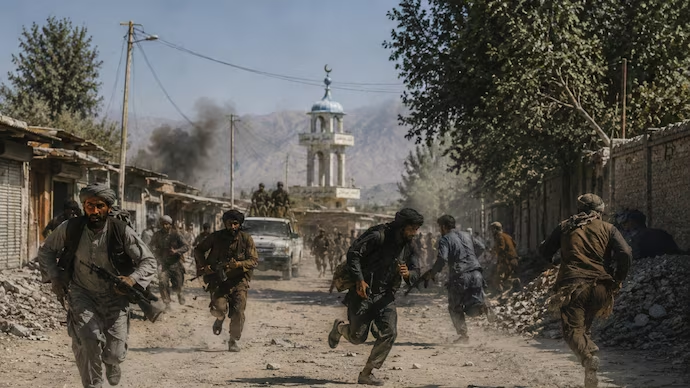
The security situation in Afghanistan has drawn fresh attention after an armed anti-Taliban group claimed it briefly captured a district headquarters in the country’s northeastern Badakhshan province before withdrawing. While Taliban authorities insist they regained control within hours, the incident has sparked debate over whether organized resistance inside Afghanistan is beginning to re-emerge.
If independently verified, the development would represent the first publicly reported case since the Taliban returned to power in August 2021 where a district headquarters temporarily slipped from its control.
Anti-Taliban Fighters Claim Temporary Control
According to local reports, armed fighters launched an early morning assault on the Yaftal-e-Paeen district headquarters in Badakhshan province, a strategically important region bordering Pakistan, Tajikistan, and China.
The attackers reportedly entered government buildings, disarmed local Taliban personnel, and raised the flag of a newly announced resistance group known as Sepahian-e Mihan, which translates to Soldiers of the Homeland.
Witness accounts suggested the fighters remained in control for several hours before leaving the area. Their destination remains unknown.
The Taliban later confirmed that an attack had taken place but rejected claims that the district had fallen for any significant period.
Taliban Says Situation Was Quickly Restored
Taliban officials described the incident as a short-lived security breach rather than a major military setback.
Authorities said security forces responded rapidly, restored control, and arrested several suspects believed to have participated in the operation. Investigations are continuing, and additional arrests may follow.
Officials also acknowledged that the attack occurred while senior district officials were reportedly away, a factor that may have contributed to the temporary disruption.
Despite the incident, Taliban leaders maintain that their nationwide security control remains intact.
Why Badakhshan Is Strategically Important
Badakhshan holds major strategic importance because of its location in northeastern Afghanistan.
The province shares borders with Pakistan, Tajikistan, China, and the narrow Wakhan Corridor, making it one of Afghanistan’s most sensitive border regions.
Its mountainous terrain has historically provided shelter for various armed groups and resistance movements. The province is also close to Panjshir Valley, long regarded as the center of anti-Taliban resistance.
Security developments in Badakhshan are therefore closely watched by regional governments and international observers alike.
Who Are the Soldiers of the Homeland?
The group calling itself Sepahian-e Mihan has only recently emerged and remains relatively unknown.
During the reported operation, fighters publicly introduced the organization by displaying its flag over the district headquarters.
Observers have noted that the group’s emblem features historical and cultural Afghan symbols, including mountains, the mythical Simurgh bird, a sword, and the sun. The imagery appears designed to emphasize Afghan national identity rather than any specific political ideology.
Taliban officials have described the organization as a newly formed group with limited capabilities.
Who Leads the New Resistance Group?
The reported leader of Sepahian-e Mihan is Qayum Khan Malang, a former officer in Afghanistan’s previous national army.
Before the Taliban takeover in 2021, he reportedly served in military operations against Taliban forces. After the collapse of the former government, he later joined the National Resistance Front before eventually forming his own armed organization following internal disagreements.
His background has attracted attention because of his previous military experience and local connections in Badakhshan.
Does the Incident Change Afghanistan’s Security Situation?
Although the reported takeover lasted only a few hours, analysts believe the incident carries symbolic importance.
Since returning to power in 2021, the Taliban has maintained control over nearly all of Afghanistan despite occasional attacks from resistance groups.
A temporary loss of a district headquarters—even if brief—could signal that smaller opposition groups are attempting to become more organized.
However, experts caution that a single operation does not indicate a major shift in the country’s balance of power.
The Taliban continues to control Afghanistan’s major cities, military infrastructure, and government institutions.
Growing Challenges for Taliban Rule
Afghanistan continues to face political, economic, and humanitarian challenges alongside ongoing security concerns.
While large-scale fighting has significantly declined compared to previous years, isolated attacks by resistance groups continue in several provinces.
Some opposition organizations hope to build wider political and military support, while the Taliban insists these groups pose no serious threat.
The latest incident highlights that armed resistance has not completely disappeared, even as the Taliban enters another year of governing the country.
Whether the emergence of Sepahian-e Mihan represents a temporary development or the beginning of a larger resistance movement remains uncertain.
For now, the reported operation in Badakhshan serves as a reminder that Afghanistan’s security landscape remains fragile, particularly in its remote border regions where geography, history, and politics continue to shape events.
Frequently Asked Questions (FAQs)
1. What happened in Afghanistan’s Badakhshan province?
An anti-Taliban group claimed it briefly captured the Yaftal-e-Paeen district headquarters before withdrawing. The Taliban says it quickly regained control.
2. Where is Yaftal-e-Paeen located?
The district is located in Badakhshan province in northeastern Afghanistan near the borders with Pakistan, Tajikistan, and China.
3. Who are Sepahian-e Mihan?
Sepahian-e Mihan, or Soldiers of the Homeland, is a newly announced armed anti-Taliban group that claimed responsibility for the operation.
4. Who leads the new resistance group?
The group is reportedly led by former Afghan National Army officer Qayum Khan Malang.
5. Did the Taliban lose permanent control of the district?
No. Taliban authorities say security forces restored control within hours after the attack.
6. Why is Badakhshan strategically important?
The province borders several countries and includes the Wakhan Corridor, making it a key security and geopolitical region.
7. Does this signal a major comeback for anti-Taliban resistance?
While symbolically important, experts say one brief operation does not significantly alter the overall balance of power.
8. What is the National Resistance Front (NRF)?
The NRF is one of Afghanistan’s main anti-Taliban resistance movements led by Ahmad Massoud.
9. Why is this incident receiving attention?
If independently confirmed, it would be the first reported case since 2021 of anti-Taliban fighters temporarily taking control of an Afghan district headquarters.
10. What happens next?
Authorities continue investigations while analysts monitor whether the new resistance group carries out additional operations in Afghanistan.
Leave a Reply