

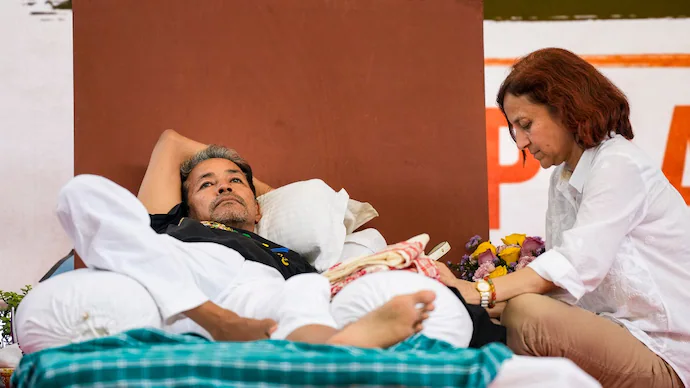
A fresh legal battle has emerged over activist Sonam Wangchuk’s ongoing treatment at Safdarjung Hospital, with his wife, Gitanjali J. Angmo, approaching the Delhi High Court against an earlier order that declined to intervene in the matter.
The appeal questions whether Wangchuk is being kept at the government hospital without lawful authority and raises broader concerns over an individual’s right to decide on medical treatment during a hunger strike. The High Court is scheduled to hear the matter later on Monday.
Appeal Questions Hospital Stay and Medical Consent
In her petition, Angmo has argued that the previous court order effectively leaves Wangchuk confined to the hospital without any formal arrest while denying both him and his family meaningful control over medical decisions.
The appeal primarily focuses on the principle of informed consent, asserting that every individual has the legal right to either accept or refuse medical treatment.
According to the plea, the earlier order did not adequately address these constitutional and legal concerns regarding personal autonomy and medical decision-making.
Earlier Court Declined Immediate Transfer
The latest appeal follows a decision delivered a day earlier by a single judge of the Delhi High Court, who refused to direct Wangchuk’s immediate transfer to a private hospital.
The court observed that authorities acted within their powers by shifting the activist from the protest site at Jantar Mantar to Safdarjung Hospital, considering his deteriorating medical condition after a prolonged hunger strike.
The order also noted that a team of doctors at the government hospital was continuously monitoring his health.
Court Leaves Medical Decisions to Doctors
While declining interim relief, the court stated that medical professionals attending Wangchuk would determine the appropriate course of treatment in accordance with established medical protocols.
The judge also observed that since Wangchuk had not voluntarily admitted himself to any medical facility despite concerns about his health, authorities were justified in taking preventive medical action.
The court further noted that there was no material indicating that treatment was being forcibly administered in violation of his bodily integrity.
Background of the Hunger Strike
Wangchuk has been observing a hunger strike since June 28, demanding action over alleged irregularities in competitive examinations and raising concerns over the deaths of several students following the earlier cancellation of the NEET examination.
On the 21st day of his protest, Delhi Police shifted him from the protest site to Safdarjung Hospital for medical supervision.
His transfer has since become the centre of legal proceedings, with his family arguing that the move has restricted his personal liberty and decision-making rights.
Legal Debate Focuses on Personal Autonomy
The fresh appeal brings attention to a wider legal issue concerning the rights of individuals undergoing medical treatment while participating in public protests.
The case is expected to examine whether a competent adult on a hunger strike can independently decide the nature of medical care received and the extent to which state authorities may intervene in the interest of preserving life.
Legal experts believe the outcome could have broader implications for questions involving informed consent, patient autonomy and state responsibility.
High Court Hearing Expected Later Today
The Delhi High Court is expected to hear Angmo’s appeal later on Monday.
The proceedings are likely to determine whether any interim relief is warranted regarding Wangchuk’s continued stay at Safdarjung Hospital or whether the earlier judicial order will remain in force while the case continues.
The court’s decision could also provide greater clarity on the balance between individual rights and government intervention during prolonged public protests involving health emergencies.
Frequently Asked Questions (FAQs)
1. Why has Sonam Wangchuk’s wife approached the Delhi High Court?
She has challenged the earlier court order that declined to transfer Wangchuk to a private hospital and argues that he is being kept at Safdarjung Hospital without lawful authority.
2. What is the main issue raised in the appeal?
The appeal focuses on informed consent and whether Wangchuk has the right to decide his own medical treatment while on a hunger strike.
3. Why was Sonam Wangchuk shifted to Safdarjung Hospital?
Authorities transferred him from Jantar Mantar after his health reportedly deteriorated during his prolonged hunger strike.
4. What did the earlier High Court order say?
The court held that the government acted within its powers by moving Wangchuk to the hospital and allowed doctors to make treatment decisions based on medical protocols.
5. When is the next hearing in the case?
The Delhi High Court is scheduled to hear the fresh appeal later on Monday.
6. What broader legal issue does the case involve?
The matter raises questions about patient autonomy, informed consent and the extent of state intervention in medical treatment during public protests.
7. What is Sonam Wangchuk protesting?
He has been on hunger strike over alleged irregularities in competitive examinations and concerns relating to the deaths of students following the earlier cancellation of the NEET examination.
8. Could the case have wider legal implications?
Yes. The court’s ruling may help clarify legal principles governing medical consent, personal liberty and state responsibility in similar situations.
Leave a Reply