

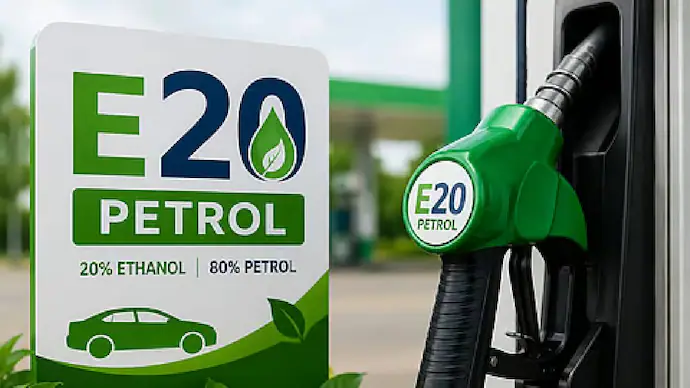
India has no immediate plans to increase ethanol blending in petrol beyond the existing 20% level, the government has confirmed. Officials said any future decision to raise the blending percentage will only be taken after detailed scientific studies and consultations with automobile manufacturers, oil companies and research organisations.
The clarification comes as questions continue over whether higher ethanol blends could affect vehicle performance and whether India is preparing to move beyond E20 fuel.
Government Says No Decision on Higher Ethanol Blend Yet
The Ministry of Petroleum and Natural Gas informed Parliament that no proposal has been approved to raise ethanol blending above the current 20% level.
Officials explained that any future move will be based on extensive research, technical evaluations and discussions with all major stakeholders. The government wants to ensure that any policy change supports environmental goals without affecting vehicle reliability or fuel infrastructure.
India achieved its target of 20% ethanol blending in petrol much earlier than originally planned, marking a major milestone in the country’s clean fuel programme.
India Achieved E20 Target Ahead of Schedule
The country’s ethanol blending journey has seen remarkable growth over the past decade.
Average ethanol blending has increased from around 1.53% during 2013-14 to 20% in the 2025-26 supply year, achieving the national target nearly five years ahead of schedule.
The Ethanol Blended Petrol (EBP) Programme has become one of India’s largest renewable fuel initiatives, reducing dependence on imported crude oil while promoting cleaner transportation fuels.
Officials believe the programme has strengthened India’s energy security and reduced its exposure to fluctuations in global crude oil prices.
Government Highlights Economic and Environmental Gains
Authorities said the ethanol blending programme has delivered multiple benefits for the economy, farmers and the environment.
Key achievements highlighted include:
- Saving more than Rs 1.97 trillion in foreign exchange by lowering crude oil imports.
- Replacing nearly 316 lakh tonnes of crude oil.
- Preventing approximately 952 lakh tonnes of carbon dioxide emissions.
- Generating additional income exceeding Rs 1.66 lakh crore for Indian farmers.
The programme has also encouraged domestic production of biofuels while supporting agricultural income through increased demand for approved feedstocks.
No Major Complaints Linked to E20 Fuel
The government also addressed concerns that E20 petrol may damage engines or fuel systems.
Officials stated that no widespread or verified complaints have been received from vehicle manufacturers, automobile associations or consumer organisations regarding engine failures, corrosion, fuel pump damage or water contamination caused by E20 fuel.
Scientific assessments of concerns circulating through traditional and social media have also not found evidence of large-scale mechanical problems linked to ethanol-blended petrol.
Millions of two-wheelers and petrol cars, including many not originally certified for E20, have reportedly been operating on higher ethanol blends for several years without widespread failures.
Vehicle Compatibility and Mileage Explained
Government data indicates that E20 fuel remains suitable for most modern petrol vehicles.
Service records examined from major automobile manufacturers reportedly found no significant engine damage linked to ethanol-blended petrol, even among many vehicles that were not initially designed specifically for E20.
However, officials acknowledged that older vehicles originally built for E10 fuel may experience a slight reduction in mileage, generally around 3% to 5%.
At the same time, E20 fuel offers higher octane levels and cleaner combustion, which can contribute to improved engine efficiency under suitable operating conditions.
Manufacturers also continue to honour vehicle warranties when standard E20 fuel is used.
Food Security and Water Usage Remain Under Watch
Questions have also been raised over whether ethanol production could affect food supplies or water resources.
The government said only surplus food grains are used for ethanol production after meeting requirements under the Public Distribution System, food security programmes and national buffer stock norms.
During the latest supply year, rice used for ethanol production increased while maize utilisation declined, reflecting diversification in feedstock selection.
Officials maintained that retail prices of rice and sugar have not been negatively affected due to ethanol production.
The government also described the ethanol programme as a “waste-to-wealth” initiative that promotes efficient use of agricultural resources.
Maize Becoming a Bigger Source of Ethanol
India’s ethanol industry is gradually reducing its dependence on sugarcane.
Officials said maize now contributes around 37% of the country’s ethanol production, helping diversify raw material sources and reduce pressure on any single crop.
In addition, ethanol manufacturing plants are required to operate as zero-liquid-discharge units, ensuring wastewater is treated and recycled rather than released into the environment.
Authorities estimate that around 3 to 5 litres of processed water are used to produce one litre of ethanol under existing industrial practices.
No Separate Supply of Lower Ethanol Petrol Planned
The government also ruled out introducing lower-blend or non-blended petrol at selected fuel stations.
Officials said maintaining multiple fuel supply chains would significantly increase operational costs while reducing the environmental and economic benefits achieved through the nationwide ethanol blending programme.
For now, E20 petrol will continue to remain the standard fuel under India’s current blending policy, while any future increase beyond 20% will depend on scientific evidence, technological readiness and industry-wide consultations.
Frequently Asked Questions (FAQs)
1. Is India planning to increase ethanol blending beyond 20%?
No. The government has confirmed that there is currently no decision to increase ethanol blending beyond E20.
2. What is E20 fuel?
E20 fuel is petrol blended with 20% ethanol and 80% conventional petrol.
3. Why is India promoting ethanol blending?
The programme aims to reduce crude oil imports, lower carbon emissions, improve energy security and increase farmers’ income.
4. Does E20 fuel damage vehicle engines?
The government says there is no verified evidence of widespread engine damage or fuel system failures caused by E20 fuel.
5. Can older vehicles run on E20 petrol?
Many older vehicles are using E20 fuel, although some designed for E10 may experience a slight reduction in fuel efficiency.
6. Does E20 reduce vehicle mileage?
Older vehicles may see mileage decrease by around 3% to 5%, while newer E20-compatible vehicles are designed to operate efficiently.
7. Which crops are used to produce ethanol in India?
Sugarcane, maize and surplus food grains are among the major feedstocks used for ethanol production.
8. Does ethanol production affect food security?
The government says only surplus grains are diverted after meeting food security and buffer stock requirements.
9. Will fuel stations offer E10 and E20 separately?
No. There is currently no proposal to introduce separate lower-blend petrol supplies.
10. What factors will decide future ethanol blending levels?
Any future increase beyond E20 will depend on scientific research, vehicle compatibility, stakeholder consultations and technological readiness.
Leave a Reply