

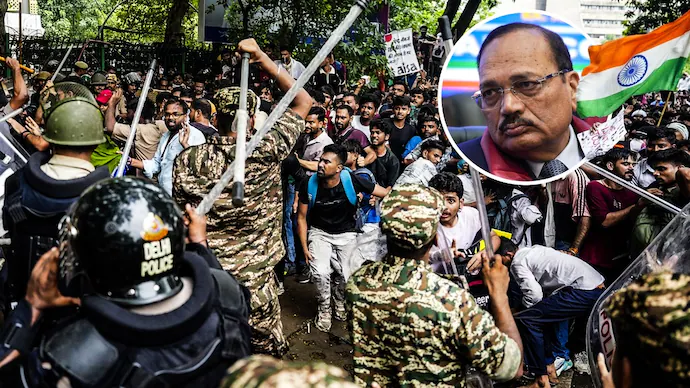
The Supreme Court on Wednesday declined to urgently hear a petition seeking intervention over the alleged police action against student protesters participating in the Cockroach Janta Party (CJP) agitation at Delhi’s Jantar Mantar.
Chief Justice of India Surya Kant, heading the bench, refused the request after a lawyer mentioned the matter for urgent consideration, stating that the court was not inclined to entertain it immediately.
CJI Rejects Plea for Immediate Intervention
During the mentioning, the lawyer urged the bench to take suo motu notice of the alleged police action against students protesting over examination-related issues, including the NEET-UG 2026 paper leak and demands for reforms in the National Testing Agency (NTA).
The Chief Justice responded sharply, asking the counsel not to waste the court’s time.
When the lawyer referred to videos that allegedly showed police excesses during the protest, the bench made it clear that it would not examine video material at this stage.
“We don’t have time. We don’t want to watch videos,” the Chief Justice remarked while declining an urgent hearing.
Protest Focused on NEET and Exam Reforms
The ongoing protest at Jantar Mantar has centred on demands for greater accountability over alleged irregularities in competitive examinations, including the NEET-UG 2026 paper leak.
Student groups and supporters have been calling for structural reforms in the examination system and action against those responsible for alleged lapses.
The movement has also demanded the resignation of Union Education Minister Dharmendra Pradhan.
How the CJP Movement Grew
The Cockroach Janta Party (CJP) emerged earlier this year as a satirical movement following remarks made by Chief Justice Surya Kant about unemployed youth entering journalism and activism. The comments triggered widespread debate before the Chief Justice clarified that his observations were directed only at individuals possessing fake or bogus degrees.
Since then, the CJP has rapidly expanded its presence on social media and evolved into a larger protest movement, attracting significant public participation across the country.
Sonam Wangchuk Joined the Protest
Education reform activist Sonam Wangchuk joined the protest on June 28 and began an indefinite hunger strike in support of the students’ demands.
Authorities later shifted him from the protest site to a hospital after concerns were raised over his deteriorating health. The move followed legal proceedings and medical advice.
Recent Protest Escalated Tensions
The agitation intensified after the CJP called for a “Chalo Sansad” march, drawing large crowds toward Parliament. The demonstrations resulted in clashes with police, leading to allegations of excessive force and multiple detentions.
The issue has also reached the Delhi High Court. Earlier this week, the High Court declined to urgently hear a similar plea challenging the police action, observing that the court should not be drawn into the matter at that stage.
As of now, the Supreme Court has also chosen not to intervene urgently, leaving the legal challenge pending through the normal judicial process.
FAQ
Why did the Supreme Court refuse an urgent hearing?
The bench led by Chief Justice Surya Kant declined to urgently hear the petition, stating it was not inclined to entertain the matter immediately and expressing no interest in reviewing video evidence during the mentioning.
What are the CJP protesters demanding?
The protesters are seeking action over alleged NEET-UG 2026 examination irregularities, reforms in the National Testing Agency, and accountability from the government, including the resignation of the Union Education Minister.
Who is Sonam Wangchuk and why is he involved?
Education reform activist Sonam Wangchuk joined the student protest and began an indefinite hunger strike in support of demands for examination reforms and greater transparency.
Has any other court heard the matter?
The Delhi High Court also declined to urgently hear a plea regarding the police action, leaving the matter to proceed through the normal legal process.
Leave a Reply