

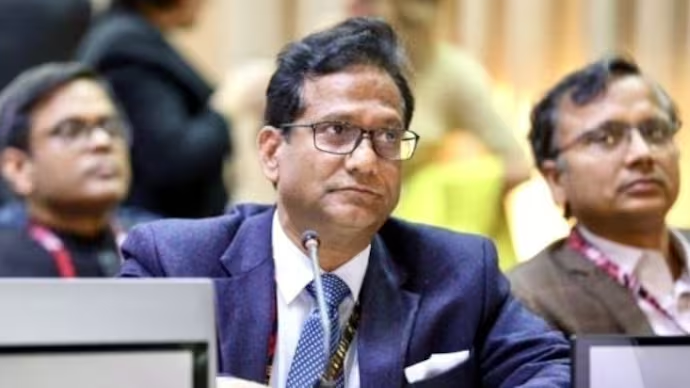
India’s higher education sector has entered a new administrative phase with Naresh Pal Gangwar assuming charge as the Higher Education Secretary. His appointment comes at a critical time as the Ministry of Education continues to work on several pending reforms under the National Education Policy (NEP) 2020, while also addressing concerns over entrance examination transparency.
The new leadership takes over amid ongoing discussions surrounding NEET UG, CUET, the National Testing Agency (NTA), and broader reforms aimed at modernising India’s higher education system.
Major Higher Education Reforms Awaiting Implementation
Despite significant policy announcements over the past few years, several structural reforms proposed under NEP 2020 are yet to be fully implemented. These initiatives are expected to remain among the top priorities for the Higher Education Department.
1. Single Higher Education Regulator
One of the flagship proposals under NEP 2020 is the creation of a unified higher education regulator through the proposed Viksit Bharat Shiksha Adhishthan (VBSA).
The objective is to streamline governance by replacing multiple regulatory bodies with a single umbrella institution responsible for oversight across higher education.
However, the proposal is still under parliamentary review, with discussions continuing over institutional autonomy, funding, and governance.
2. Four Independent Governance Verticals
The education policy also proposes separating regulation, accreditation, funding, and academic standards into four independent bodies.
Although consultations have progressed, universities continue to function under the existing framework, resulting in overlapping regulations and multiple compliance requirements.
Academic Bank of Credits Still Needs Wider Adoption
The Academic Bank of Credits (ABC) has already been introduced, enabling students to digitally store academic credits earned across institutions.
However, many universities are yet to fully implement credit portability, interdisciplinary learning, and multiple entry-exit options envisioned under NEP 2020.
Students seeking to transfer credits between institutions or states continue to face practical challenges.
Foreign Universities Yet to Expand Presence in India
The University Grants Commission (UGC) has introduced regulations allowing leading international universities to establish campuses in India.
While a limited number of institutions have announced plans, broader participation remains slow due to concerns surrounding regulatory procedures, infrastructure, academic independence, and financial feasibility.
NEET, CUET and NTA Reforms Remain a Key Focus
One of the most closely watched areas will be reforms related to the National Testing Agency (NTA) and major entrance examinations, including NEET UG and the Common University Entrance Test (CUET).
Recent concerns over examination security and irregularities have highlighted the need for stronger governance, improved transparency, secure digital systems, and greater accountability throughout the examination process.
The government is also working on strengthening technology-driven assessment systems that can improve fairness and efficiency across universities.
A Crucial Phase for Higher Education
The appointment of Naresh Pal Gangwar comes as India’s higher education system balances immediate concerns surrounding entrance examinations with long-term institutional reforms envisioned under NEP 2020.
Students, universities, and education stakeholders will closely watch the pace of implementation in the coming months as the ministry works toward improving governance, academic flexibility, and examination credibility.
Key Highlights
- Naresh Pal Gangwar has taken charge as Higher Education Secretary.
- Several NEP 2020 reforms remain pending.
- Proposed single higher education regulator is still under review.
- Academic Bank of Credits requires wider implementation.
- Expansion of foreign universities in India remains gradual.
- NEET UG, CUET and NTA reforms continue to be major priorities.
- Examination transparency and digital security remain key focus areas.
FAQs
1. Who is the new Higher Education Secretary of India?
Naresh Pal Gangwar has assumed charge as the new Higher Education Secretary.
2. What are the major challenges before the new Higher Education Secretary?
Key priorities include reforms related to NEET UG, CUET, NTA, NEP 2020 implementation, Academic Bank of Credits, and higher education governance.
3. What is the Academic Bank of Credits (ABC)?
ABC is a digital platform that allows students to store, transfer, and utilize academic credits earned from different institutions.
4. What is the proposed VBSA?
The Viksit Bharat Shiksha Adhishthan (VBSA) is a proposed unified regulator for higher education aimed at replacing multiple regulatory bodies.
5. Will NEET UG undergo reforms?
The government is working on improving examination governance, transparency, and security, though no immediate changes have been officially implemented.
6. What changes are expected in CUET?
CUET is expected to benefit from broader examination reforms focused on improving transparency, digital systems, and operational efficiency.
7. Why are higher education reforms important?
The reforms aim to simplify governance, improve academic flexibility, strengthen examination systems, and enhance the quality of higher education.
8. Can students currently transfer credits between universities?
Credit transfer is available through the Academic Bank of Credits, but implementation varies across institutions.
9. Will foreign universities be able to open campuses in India?
UGC regulations allow eligible foreign universities to establish campuses, although expansion is still in the early stages.
10. What is the main objective of NEP 2020 in higher education?
NEP 2020 aims to modernize higher education through flexible learning, improved governance, digital transformation, multidisciplinary education, and enhanced global competitiveness.
Leave a Reply