

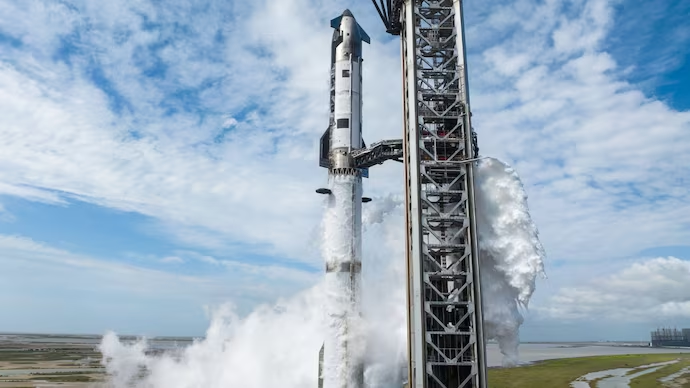
SpaceX has postponed the highly anticipated Starship Flight 13 launch after unfavorable weather conditions prevented the company from proceeding with the scheduled test mission. The next launch attempt is now planned during a revised launch window that falls in the early hours of Saturday (IST).
The delay comes as SpaceX aims to collect critical data during one of the most important Starship test flights to date, including high-quality imagery of the spacecraft’s heat shield during ascent.
Why Was the Starship Launch Delayed?
According to SpaceX, poor weather conditions reduced visibility around the launch site, making it difficult to capture clear ground-based images of Starship’s heat shield as the vehicle travels through high dynamic pressure during launch.
The company decided to postpone the mission until weather conditions improve, ensuring engineers can obtain the visual data needed to evaluate the spacecraft’s thermal protection system.
Previous Launch Attempt Ended in Last-Minute Abort
The latest delay follows an earlier launch attempt that was called off just moments before liftoff because of an engine startup issue.
Following the aborted countdown, SpaceX replaced two Raptor engines, completed additional inspections, and carried out extensive system checks before preparing the vehicle for another launch opportunity.
What Makes Starship Flight 13 Important?
Starship Flight 13 is expected to test several key technologies that are essential for future deep-space missions.
Among the primary objectives are:
- Capturing detailed imagery of the heat shield during ascent.
- Evaluating the performance of the upgraded Starship vehicle.
- Demonstrating satellite deployment capabilities.
- Collecting flight performance data for future missions.
The mission is another step toward making Starship a fully reusable launch system capable of carrying cargo and astronauts on long-duration space missions.
Starlink Satellite Deployment Test
The test flight is also expected to carry 20 Starlink satellites.
These satellites are planned to follow a suborbital trajectory during the mission before safely re-entering Earth’s atmosphere and burning up, allowing SpaceX to validate deployment systems for future operational flights.
World’s Largest and Most Powerful Rocket
Standing approximately 123 metres tall, Starship is currently the world’s largest and most powerful rocket system.
The launch vehicle consists of two reusable stages:
- Super Heavy Booster, which provides liftoff thrust.
- Starship spacecraft, designed for missions to Earth orbit, the Moon, Mars, and beyond.
The fully reusable design is central to SpaceX’s long-term goal of significantly reducing the cost of space travel.
Starship’s Role in Future Space Missions
Since beginning its flight testing program in 2023, SpaceX has completed 12 Starship test flights, achieving important milestones including successful stage separation, controlled splashdowns, and continuous improvements to the launch system.
The rocket is expected to play a significant role in upcoming commercial missions as well as NASA’s Artemis program, which aims to return astronauts to the Moon and support future human exploration of Mars.
Key Highlights
- SpaceX postponed Starship Flight 13 because of unfavorable weather.
- New launch attempt is scheduled for Saturday (IST).
- Mission aims to capture detailed heat shield imagery.
- Earlier launch was aborted due to a Raptor engine startup issue.
- SpaceX replaced two engines before preparing for the next attempt.
- Flight will test deployment of 20 Starlink satellites.
- Starship remains the world’s tallest and most powerful rocket.
- The rocket will support future Moon and Mars missions.
FAQs
1. Why was SpaceX Starship Flight 13 delayed?
The launch was postponed due to unfavorable weather conditions that affected visibility required for mission objectives.
2. When is the new Starship Flight 13 launch scheduled?
The revised launch attempt is expected during a launch window that falls in the early hours of Saturday (IST).
3. What is the main objective of Starship Flight 13?
The mission aims to capture detailed images of Starship’s heat shield, test vehicle performance, and evaluate satellite deployment systems.
4. Why is the heat shield important?
The heat shield protects Starship during atmospheric re-entry and is critical for achieving full reusability.
5. Why was the previous launch attempt aborted?
The earlier countdown was halted because of an engine startup issue involving the Raptor engines.
6. How many Starlink satellites will the mission carry?
Starship Flight 13 is expected to carry 20 Starlink satellites for a deployment demonstration.
7. How tall is the Starship rocket?
Starship stands approximately 123 metres tall, making it the world’s largest and most powerful rocket.
8. What is the Super Heavy booster?
Super Heavy is the first-stage booster that provides the thrust required to launch Starship into space.
9. How many Starship test flights has SpaceX completed?
SpaceX has conducted 12 Starship test flights since 2023 as part of the rocket’s development program.
10. What is Starship’s long-term mission?
Starship is being developed for reusable missions to Earth orbit, the Moon, Mars, satellite launches, and NASA’s Artemis lunar exploration program.
Leave a Reply