

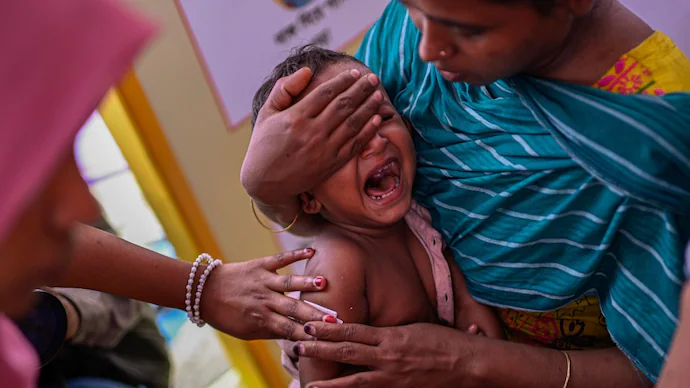
India has reported 26,627 measles cases during the first half of 2026, making it the country with the world’s second-highest reported number of infections this year. The increase has raised fresh concerns about the country’s progress toward eliminating measles and rubella, while also prompting questions about disease surveillance and the availability of detailed public health data.
The latest figures show that infections have already surpassed the total number of measles cases recorded throughout 2025, even though the year is only halfway complete.
Measles Cases Exceed Last Year’s Total
Recent international surveillance data indicates that India has recorded 26,627 measles infections so far in 2026. This is significantly higher than the 18,794 cases reported during all of 2025.
Among all countries, only Bangladesh has reported a higher number of measles infections this year. The neighbouring country has been dealing with a large-scale outbreak, reporting more than 42,000 cases and hundreds of deaths, highlighting the continued regional threat posed by the highly contagious disease.
Measles Remains a Serious Public Health Concern
Measles is one of the world’s most contagious viral infections. Although it can be prevented through vaccination, it continues to pose serious health risks, especially for infants and young children who remain unvaccinated or have weakened immunity.
The disease spreads through respiratory droplets released when an infected person coughs, sneezes, or talks. Symptoms generally appear within 10 to 14 days after exposure and commonly include:
- High fever
- Persistent cough
- Runny nose
- Red or watery eyes
- Sore throat
- A red skin rash that spreads across the body
While many children recover completely, measles can lead to severe complications such as pneumonia, brain inflammation (encephalitis), hearing loss, and, in some cases, death.
India’s Elimination Goal Faces Fresh Challenges
India has set a target of eliminating measles and rubella by 2026, following earlier deadlines that were not achieved.
The current rise in infections has renewed attention on whether the country can meet that objective. Public health experts say that alongside vaccination, rapid detection of new cases and timely outbreak control are essential for achieving elimination.
Another issue drawing attention is the limited availability of publicly accessible information about where infections are occurring. While overall national figures are available, detailed state-wise or district-wise data has not been widely published, making it difficult to assess local transmission patterns.
Measles Cases Show Changing Trend Since 2021
India’s reported measles cases have fluctuated considerably over the past several years.
| Year | Reported Cases |
|---|---|
| 2021 | 6,025 |
| 2022 | 43,578 |
| 2023 | 68,794 |
| 2024 | 20,635 |
| 2025 | 18,794 |
| 2026* | 26,627 |
*Figures represent the first half of 2026.
The significant increase in 2022 and 2023 was largely linked to disruptions in routine childhood immunisation during the COVID-19 pandemic, when vaccination services were affected across many regions.
Vaccination Coverage Continues to Improve
Despite the increase in reported cases, India’s vaccination coverage has shown encouraging progress.
Recent immunisation estimates indicate:
- 98% coverage for the first dose of the measles vaccine in 2025.
- 95% coverage for the second dose, marking a notable improvement over previous years.
Health experts believe that stronger vaccination coverage is helping reduce the overall risk of widespread outbreaks. However, they stress that maintaining these high levels while identifying local clusters quickly remains essential.
Under the Universal Immunisation Programme, children receive two doses of the Measles-Rubella (MR) vaccine. The Measles-Mumps-Rubella (MMR) vaccine is also available through private healthcare providers.
Why Early Vaccination Matters
There is currently no specific antiviral medicine that cures measles once infection develops. Treatment mainly focuses on relieving symptoms, preventing complications, maintaining hydration, and providing vitamin A supplementation where recommended.
Medical experts also note that measles can temporarily weaken the immune system, leaving children more vulnerable to other infections for months after recovery.
Ensuring children receive both recommended vaccine doses remains the most effective way to prevent severe illness and reduce transmission.
What Lies Ahead
The latest rise in measles cases serves as an important reminder that continuous vaccination efforts, effective disease surveillance, and rapid public health responses remain vital. As India continues working toward its long-standing measles elimination goal, strengthening routine immunisation and improving outbreak monitoring will play a crucial role in reducing future infections.
Frequently Asked Questions (FAQs)
1. How many measles cases has India reported in 2026?
India has reported 26,627 measles cases during the first half of 2026.
2. Why are measles cases increasing?
Health experts believe immunity gaps created during the COVID-19 pandemic, along with local transmission, have contributed to the rise in cases.
3. Is measles a preventable disease?
Yes. Measles can be effectively prevented through vaccination.
4. What are the common symptoms of measles?
Symptoms include fever, cough, runny nose, red eyes, sore throat, and a widespread red rash.
5. How does measles spread?
The virus spreads through respiratory droplets when an infected person coughs, sneezes, or talks.
6. Does India provide free measles vaccination?
Yes. The Measles-Rubella (MR) vaccine is provided under the Universal Immunisation Programme.
7. Is there a cure for measles?
There is no specific antiviral treatment. Medical care focuses on symptom management and preventing complications.
8. Why is vaccination important?
Vaccination protects individuals from severe illness and helps reduce community transmission.
9. What complications can measles cause?
Possible complications include pneumonia, encephalitis, hearing problems, severe dehydration, and, in rare cases, death.
10. What should parents do to protect children?
Parents should ensure children receive both recommended doses of the measles vaccine and seek medical advice promptly if symptoms develop.
Leave a Reply