

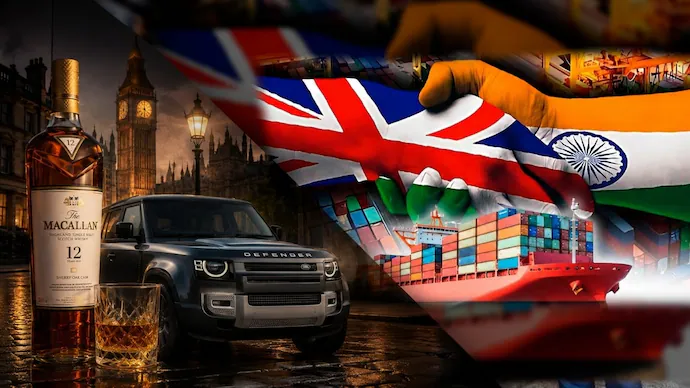
India’s landmark Comprehensive Economic and Trade Agreement (CETA) with the United Kingdom officially came into force on July 15, marking one of the country’s biggest trade reforms in recent years. The agreement is expected to reshape trade between the two nations by reducing tariffs, opening new markets for exporters and creating fresh opportunities for businesses and skilled professionals.
While Indian consumers may gradually benefit from lower prices on imported British products such as Scotch whisky, premium cars and chocolates, the biggest winners are likely to be exporters, manufacturers and service providers seeking greater access to the UK market.
Here are the top 10 changes that the India-UK FTA brings.
1. Scotch whisky and gin to become cheaper
One of the most noticeable changes for consumers will be lower duties on British alcoholic beverages.
Import duty on Scotch whisky has been reduced from 150% to 75% immediately and will gradually fall to 40% over the next decade. Similar tariff reductions apply to British gin.
Although prices may not decline instantly, premium imported spirits are expected to become more affordable over time as lower duties filter through the supply chain.
2. British cars to become more affordable
The agreement also paves the way for lower prices on British-made automobiles.
Import duties on fully built UK vehicles, which currently reach as high as 110%, will gradually reduce to 10% over ten years under a quota-based system.
Electric and hybrid vehicles will also receive preferential treatment, while quotas are designed to protect India’s domestic automobile industry.
3. Lower duties on chocolates, cosmetics and packaged foods
Several British consumer products will gradually become less expensive.
Products expected to benefit include:
- Chocolates
- Sweet biscuits
- Cosmetics
- Soft drinks
- Packaged food products
The tariff reductions are expected to improve product availability while offering consumers more choices.
4. Indian exporters receive nearly duty-free access to the UK
The agreement offers one of its biggest advantages to Indian exporters.
The UK has eliminated import duties on almost 99% of tariff lines, covering nearly the entire value of India’s merchandise exports.
This improves India’s competitiveness in one of its most important overseas markets.
5. Major boost for manufacturing sectors
Several labour-intensive industries are expected to gain immediate export opportunities.
These include:
- Textiles and garments
- Leather products
- Footwear
- Marine products
- Sports goods
- Toys
- Gems and jewellery
- Engineering goods
- Auto components
- Organic chemicals
Improved market access is expected to support manufacturing growth and employment across these sectors.
6. Indian professionals save on social security contributions
The Double Contribution Convention (DCC) has also become operational alongside the trade pact.
Eligible Indian professionals working temporarily in the UK will no longer need to contribute simultaneously to both Indian and UK social security systems.
Instead, they can continue building retirement savings through India’s Employees’ Provident Fund (EPF), potentially increasing their long-term retirement corpus while reducing employment costs for companies.
7. Sensitive agricultural products remain protected
The agreement does not reduce tariffs across every sector.
India has excluded several sensitive agricultural products to safeguard domestic farmers.
These include:
- Dairy products
- Apples
- Cheese
- Sugar
- Milled rice
- Pork
- Chicken
- Eggs
Existing import duties on these products will continue.
8. The FTA extends beyond trade in goods
Unlike traditional trade agreements focused only on tariffs, the India-UK pact covers a broad range of economic sectors.
Its 30 chapters include provisions covering:
- Digital trade
- Financial services
- Telecommunications
- Intellectual property
- Government procurement
- Innovation
- Sustainability
- Small and medium enterprises (MSMEs)
- Rules of origin
- Temporary movement of professionals
- Transparency
- Trade and gender equality
The agreement also promotes technology collaboration and resilient supply chains.
9. Bilateral trade expected to grow significantly
Trade between India and the UK has already been expanding.
Merchandise trade reached $25.13 billion in FY26, up from $23.13 billion in FY25.
Indian exports stood at $13.44 billion, while imports from the UK rose sharply to $11.68 billion.
Over the long term, the agreement is expected to substantially increase trade volumes, investment and business collaboration between both countries.
10. MSMEs could emerge as the biggest winners
Small and medium enterprises are expected to benefit from easier market access and lower trade barriers.
Reduced tariffs and simplified trade rules should help MSMEs expand exports, improve competitiveness and access larger international markets.
Improved financing opportunities and stronger trade partnerships are also expected to support business growth.
What the India-UK FTA means for India
The India-UK Comprehensive Economic and Trade Agreement represents one of India’s most comprehensive trade deals to date.
Beyond lowering tariffs on goods, the pact strengthens cooperation across technology, digital commerce, services, innovation and professional mobility. It also supports exporters by providing nearly complete duty-free access to the UK market while making selected British products more affordable for Indian consumers.
As implementation progresses, businesses, manufacturers, professionals and exporters are expected to benefit the most, helping deepen economic ties between India and the United Kingdom.
FAQs
1. What is the India-UK Comprehensive Economic and Trade Agreement (CETA)?
It is a free trade agreement between India and the United Kingdom that reduces tariffs, improves market access and strengthens cooperation across trade, services and investment.
2. When did the India-UK FTA come into effect?
The agreement officially came into force on July 15, 2026.
3. Which British products are expected to become cheaper in India?
Scotch whisky, gin, premium cars, chocolates, biscuits, cosmetics and several packaged consumer products are expected to become more affordable over time.
4. What benefits do Indian exporters receive?
Indian exporters now enjoy duty-free access on nearly 99% of tariff lines in the UK, making exports more competitive.
5. Which Indian industries benefit the most?
Textiles, leather, footwear, marine products, gems and jewellery, engineering goods, toys, sports goods and auto components are among the biggest beneficiaries.
6. What is the Double Contribution Convention (DCC)?
It is a social security agreement that exempts eligible Indian professionals on temporary UK assignments from making dual social security contributions.
7. Will British cars become cheaper immediately?
No. Import duties will be reduced gradually over a ten-year period under a quota-based system.
8. Are agricultural products included in the tariff reductions?
No. Sensitive products such as dairy, sugar, apples, cheese, poultry and rice remain protected under existing tariff structures.
9. How will MSMEs benefit from the agreement?
MSMEs will gain easier access to the UK market, reduced trade barriers, improved export opportunities and stronger business partnerships.
10. Why is the India-UK FTA considered significant?
The agreement is expected to boost bilateral trade, support exporters, strengthen manufacturing, improve professional mobility and deepen long-term economic cooperation between India and the United Kingdom.
Leave a Reply