

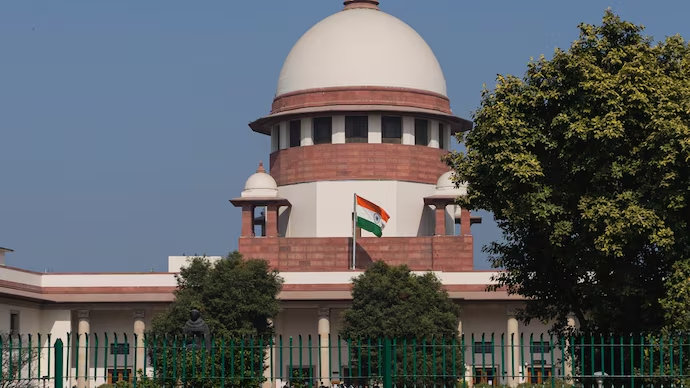
The Supreme Court has refused to grant an interim stay on the implementation of the CBSE Class 6 three-language policy, while hearing petitions challenging its rollout under the National Education Policy (NEP).
During the hearing, the court also made a significant observation, stating that the question of whether English can be considered an indigenous language may require fresh examination. The remarks have added a new dimension to the ongoing national discussion on multilingual education and language policy.
Supreme Court Refuses Interim Relief
A bench headed by Chief Justice Surya Kant, along with Justices Joymalya Bagchi and V. Mohan, heard multiple petitions challenging the implementation of the three-language formula.
The court declined to suspend the policy at this stage, observing that an interim order could not be passed without a detailed hearing.
The matter has now been scheduled for July 22, with the Centre and the CBSE directed to submit their detailed responses before the next hearing.
Court Raises Question Over English as an Indigenous Language
While hearing the matter, the bench observed that the notification appeared to support the constitutional objective of promoting Hindi and other regional languages.
The judges also remarked that the broader issue of indigenous languages—and whether English should fall within that category—deserves reconsideration.
The observation does not amount to a final ruling but has intensified discussions surrounding India’s language policy and educational framework.
Petitioners Cite Implementation Challenges
The petitioners argued that implementing the three-language formula poses significant practical difficulties for schools.
Among the concerns raised were:
- Difficulty in recruiting qualified teachers for multiple languages.
- Limited educational infrastructure.
- Shortage of textbooks and learning materials.
- Administrative challenges in offering all language options.
The petitioners noted that while students are allowed to choose from the 22 scheduled languages, many schools may struggle to provide qualified faculty for every language.
They also pointed out that although NCERT had planned to make study materials available in all scheduled languages, textbooks are currently available for only a limited number of languages.
Centre Defends the Three-Language Policy
Representing the Centre and the CBSE, government counsel informed the court that detailed replies would be filed within the time granted.
The Centre defended the policy by stating that the National Education Policy aims to build an education system rooted in India’s cultural and linguistic diversity.
According to the government’s position, the three-language formula:
- Encourages multilingual learning.
- Promotes Indian languages.
- Respects constitutional principles.
- Supports the country’s federal structure.
- Does not impose any particular language on states.
The government also maintained that the policy provides flexibility for states and schools while encouraging students to learn multiple languages.
Why the Three-Language Formula Matters
The three-language formula has remained one of the most debated aspects of India’s education policy.
Supporters argue that learning multiple languages strengthens communication skills, preserves linguistic diversity and promotes national integration.
Critics, however, believe that implementation may vary significantly across states due to differences in language preferences, teacher availability and educational resources.
The ongoing legal challenge is expected to focus on balancing educational objectives with practical implementation concerns.
What Happens Next?
The Supreme Court will continue hearing the matter on July 22, after reviewing responses from the Centre and the CBSE.
The final outcome could have a significant impact on the implementation of the three-language policy in CBSE-affiliated schools across the country.
Until then, the Class 6 policy remains in force, as the court has declined to grant interim relief.
Conclusion
The Supreme Court’s decision not to stay the CBSE Class 6 three-language policy allows its implementation to continue for now, while the constitutional and practical questions surrounding the policy remain under judicial consideration. The court’s remarks on English and indigenous languages have added fresh momentum to an already important national debate on multilingual education, with further clarity expected after the next hearing.
FAQs
1. What did the Supreme Court decide on the CBSE three-language policy?
The Supreme Court declined to grant an interim stay on the implementation of the Class 6 three-language policy.
2. Why is the CBSE three-language policy being challenged?
Petitioners argue that schools may face difficulties in implementing the policy due to shortages of teachers, textbooks and infrastructure.
3. What observation did the Supreme Court make about English?
The court remarked that the question of whether English can be regarded as an indigenous language may require fresh consideration.
4. Has the three-language policy been suspended?
No. The policy remains in effect because the Supreme Court refused to issue an interim stay.
5. When will the Supreme Court hear the matter again?
The next hearing has been scheduled for July 22.
6. What is the three-language formula?
It is a language education policy under the National Education Policy that encourages students to learn three languages while promoting multilingual education.
7. What concerns have petitioners raised?
They have highlighted challenges related to teacher recruitment, learning resources, infrastructure and the availability of textbooks in multiple languages.
8. What is the Centre’s stand on the policy?
The Centre says the policy promotes multilingualism, supports constitutional values and provides flexibility without imposing any language on states.
9. How many scheduled languages can students choose from?
Students are allowed to choose from the 22 scheduled languages recognised under the Constitution.
10. Will the court’s final verdict affect CBSE schools?
Yes. The Supreme Court’s final decision could influence how the three-language policy is implemented across CBSE-affiliated schools in India.
Leave a Reply