

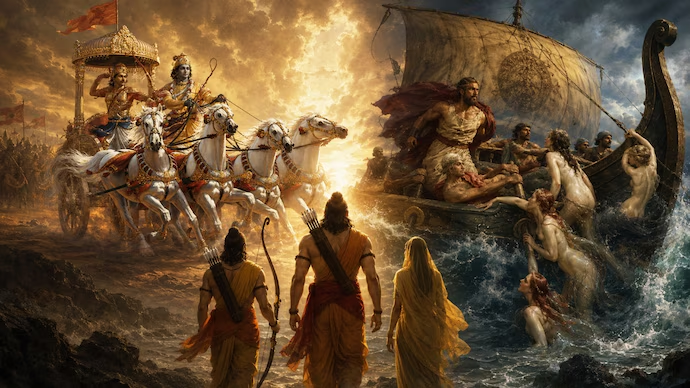
Christopher Nolan’s adaptation of The Odyssey has sparked fresh discussions among audiences worldwide, especially in India, where many viewers have noticed striking similarities between Homer’s ancient Greek epic and India’s two great epics—the Ramayana and the Mahabharata.
Although these literary masterpieces emerged from different civilizations, cultures, and religious traditions, they explore many of the same universal ideas. From exile and sacrifice to divine guidance and the longing for home, each epic tells a deeply human story that continues to resonate across generations.
At the same time, it is important to recognize that The Odyssey belongs to Greek mythology, while the Ramayana and Mahabharata remain sacred texts with profound religious and cultural significance for millions of people. The similarities reflect shared storytelling themes rather than evidence of direct influence.
A Hero’s Long Journey Home
One of the strongest connections among the three epics is the central theme of returning home after years of separation.
In The Odyssey, King Odysseus spends ten years fighting in the Trojan War before facing another decade of dangerous voyages as he struggles to return to Ithaca.
The Ramayana follows Lord Rama’s fourteen-year exile from Ayodhya, during which he overcomes numerous hardships before returning to reclaim his kingdom.
In the Mahabharata, the Pandavas lose their kingdom after a game of dice and spend years in exile before returning to fight the Kurukshetra War.
Although each journey unfolds differently, all three stories explore resilience, endurance, and the emotional cost of separation.
Supernatural Challenges Shape Every Journey
Each epic places its heroes in extraordinary situations where they confront forces beyond the ordinary world.
Odysseus battles mythical creatures including the Cyclops, encounters the Sirens, survives Scylla and Charybdis, and faces the enchantress Circe.
Lord Rama fights Ravana and encounters demons and magical illusions throughout his journey.
The Pandavas also meet powerful beings, rakshasas, sages, and divine figures during their years in the forest.
These supernatural encounters are more than exciting adventures—they test courage, wisdom, and moral character.
Temptation Becomes a Defining Test
Another common thread is the idea that temptation can change the course of destiny.
Odysseus repeatedly faces distractions, whether through the Lotus-Eaters’ promise of forgetfulness or the irresistible songs of the Sirens.
The Ramayana presents a similar turning point through the golden deer, whose illusion leads to Sita’s abduction.
In the Mahabharata, temptation appears in a different form. Pride, greed, and ambition culminate in the infamous dice game that forces the Pandavas into exile.
Across all three epics, heroes must recognize deception before it destroys everything they value.
Divine Powers Guide Human Destiny
Gods play a significant role in shaping events throughout these timeless stories.
In The Odyssey, Athena repeatedly protects Odysseus, while Poseidon creates obstacles that delay his journey.
The Ramayana unfolds within a divine framework where celestial forces influence Lord Rama’s mission.
The Mahabharata places Lord Krishna at the center of its spiritual and philosophical message, offering guidance to Arjuna before the great war.
Despite divine intervention, every hero must ultimately make difficult choices and accept the consequences of those decisions.
Families Wait Through Years of Separation
The emotional strength of these epics lies not only in the heroes’ adventures but also in the loved ones waiting for them.
Penelope remains loyal to Odysseus despite believing he may never return.
The relationship between Rama and Sita is tested through exile, separation, war, and eventual reunion.
In the Mahabharata, Draupadi, Kunti, and the broader Kuru family endure years of uncertainty as the Pandavas remain away from their kingdom.
These stories show how exile transforms not only those who leave but also those left behind.
A Kingdom Without Its Leader
Each epic also explores what happens when a rightful ruler is absent.
Odysseus’ prolonged absence allows rivals to occupy his palace and threaten his family’s future.
Rama’s exile creates uncertainty in Ayodhya, while Bharata refuses to claim the throne permanently.
The Pandavas lose their kingdom and spend years preparing to restore justice.
In every case, the hero’s return symbolizes more than personal victory—it represents the restoration of order and rightful leadership.
Different Heroes, Different Ideals
Despite these similarities, the heroes themselves embody very different ideals.
Odysseus succeeds through intelligence, adaptability, and strategic thinking.
Lord Rama is revered as the embodiment of righteousness, duty, and moral integrity.
The Pandavas, particularly Yudhishthira, wrestle with ethical dilemmas, justice, and the heavy cost of war.
These distinctions make each epic unique while highlighting different cultural perspectives on heroism.
Why These Stories Continue to Inspire
The lasting appeal of these epics lies in their exploration of universal human experiences.
Questions about loyalty, sacrifice, temptation, destiny, family, and perseverance remain relevant regardless of geography or historical period.
Christopher Nolan’s adaptation of The Odyssey has introduced a new generation to Homer’s masterpiece, while also encouraging audiences to appreciate how great stories from different civilizations can echo one another without losing their unique identities.
Conclusion
The Odyssey, Ramayana, and Mahabharata emerged independently from different traditions, and there is no established historical evidence linking their origins. Yet their enduring themes continue to connect readers across cultures.
Whether through Odysseus’ voyage back to Ithaca, Rama’s return to Ayodhya, or the Pandavas’ struggle to reclaim their kingdom, each epic reminds us that the journey home is often about much more than reaching a destination. It is a journey of courage, sacrifice, wisdom, and personal transformation that continues to inspire audiences thousands of years later.
Frequently Asked Questions (FAQs)
1. Is The Odyssey based on the Ramayana or Mahabharata?
No. There is no historical evidence that Homer’s The Odyssey was based on either Indian epic.
2. Why are people comparing these epics?
They share universal themes such as exile, homecoming, divine intervention, temptation, family, and the hero’s journey.
3. Who is the main hero of The Odyssey?
The central character is Odysseus, the king of Ithaca.
4. How long was Odysseus away from home?
He spent about twenty years away—ten years in the Trojan War and another ten years trying to return home.
5. What is the central theme of the Ramayana?
The Ramayana emphasizes duty, righteousness (dharma), devotion, sacrifice, and the triumph of good over evil.
6. What is the main message of the Mahabharata?
The epic explores justice, morality, duty, human conflict, and the consequences of choices.
7. Does Christopher Nolan’s The Odyssey retell the Indian epics?
No. It is an adaptation of Homer’s ancient Greek epic The Odyssey.
8. What role do gods play in these epics?
Divine beings influence events, guide heroes, and create challenges, but the protagonists must still make their own decisions.
9. Why do these ancient stories remain relevant?
They address timeless human experiences including courage, loyalty, family, sacrifice, temptation, and perseverance.
10. What makes these three epics different?
They originate from different civilizations and represent distinct cultural, literary, and spiritual traditions, even though they explore several common storytelling themes.
Leave a Reply