

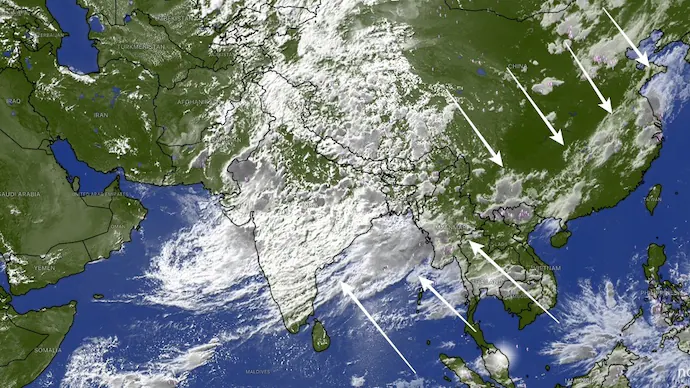
A massive 10,000-kilometre-long rain band stretching from north India to South Korea has been captured in the latest satellite imagery, marking one of the most active phases of the 2026 southwest monsoon.
The sprawling cloud formation, known as a monsoon convergence zone, extends across northern India, the Himalayas, China and East Asia, creating a nearly continuous corridor of rain-bearing clouds and widespread precipitation across the continent.
Massive Cloud Band Triggers Intense Rainfall
The impressive weather system formed as moisture-laden winds from the Indian Ocean interacted with atmospheric weather patterns across Asia.
This interaction created a broad zone of rising air, allowing moisture to condense into towering rain clouds capable of producing widespread showers and thunderstorms.
According to rainfall estimates, India recorded 170% to 180% of its normal daily monsoon rainfall over the past two days, making it the wettest spell of the season so far.
Meteorologists described the event as one of the strongest monsoon phases of the year, with rainfall significantly exceeding normal levels across several regions.
Which Areas Are Receiving Heavy Rain?
The active monsoon phase has brought widespread rainfall across large parts of the country.
Heavy showers have been reported in:
- Uttar Pradesh
- Uttarakhand
- Delhi-NCR
- Haryana
- Punjab
- Rajasthan
- Several parts of eastern and northeastern India
Low-pressure systems moving inland from the Bay of Bengal have further intensified rainfall over eastern regions.
The fresh spell is expected to improve seasonal rainfall figures, particularly in north and central India, where earlier rainfall deficits had raised concerns.
Why Is This Rain Band So Large?
Weather experts say elongated cloud bands like this develop when the monsoon trough remains highly active.
As warm, moisture-rich air converges over a vast region, it rises into the atmosphere, cools and forms extensive rain-bearing cloud systems stretching thousands of kilometres.
The latest satellite imagery highlights how the Indian monsoon is closely linked with broader atmospheric circulation patterns influencing weather across much of Asia.
Flood and Landslide Risks Increase
While the rainfall is expected to benefit agriculture and water storage, authorities have also warned about potential weather-related hazards.
Continuous heavy rain could lead to:
- Flash floods
- Urban waterlogging
- River swelling
- Landslides in hilly regions
- Travel disruptions
States such as Uttarakhand and Himachal Pradesh remain particularly vulnerable due to their mountainous terrain.
Good News for Agriculture and Reservoirs
The active monsoon spell is expected to significantly improve India’s seasonal rainfall performance.
Higher rainfall could help replenish reservoirs, support irrigation needs and provide a boost to the ongoing kharif cropping season, offering relief after earlier periods of uneven monsoon activity.
With forecasts indicating that the southwest monsoon will remain active through the week, meteorologists expect rainfall to continue across several parts of the country while helping reduce the seasonal rainfall deficit.
Frequently Asked Questions (FAQs)
1. What is the 10,000-km rain band seen over Asia?
It is a monsoon convergence zone, a vast belt of clouds formed when moisture-rich monsoon winds interact with atmospheric weather systems, producing widespread rainfall across Asia.
2. Which countries does the rain band cover?
The cloud band stretches from north India across the Himalayas and China to South Korea, covering nearly 7,000 to 10,000 kilometres.
3. How much rainfall has India received during this active monsoon phase?
India recorded around 170% to 180% of its normal daily monsoon rainfall over the previous two days, making it one of the wettest spells of the 2026 season.
4. Which Indian states are expected to receive heavy rainfall?
Heavy rainfall is expected across Uttar Pradesh, Uttarakhand, Delhi-NCR, Haryana, Punjab, Rajasthan, along with several eastern and northeastern states.
5. What are the risks associated with this active monsoon spell?
The prolonged rainfall may increase the risk of flash floods, landslides, waterlogging, river flooding and travel disruptions, particularly in Himalayan states.
6. Will this monsoon spell benefit agriculture?
Yes. The widespread rainfall is expected to reduce seasonal rainfall deficits, replenish reservoirs and support the ongoing kharif cropping season across many parts of India.
Leave a Reply