

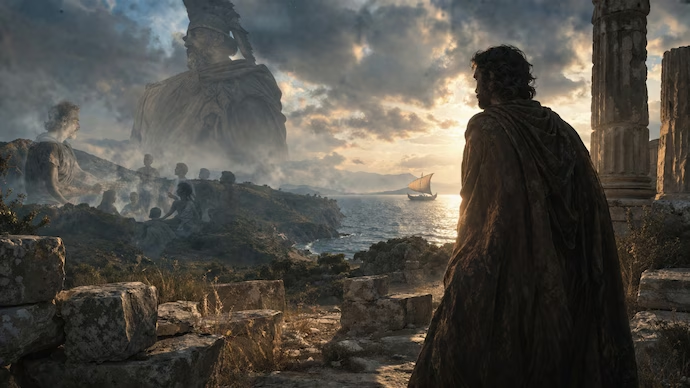
For nearly 3,000 years, one question has fascinated historians, archaeologists and lovers of mythology alike: Was Odysseus a real king, or simply one of history’s greatest fictional heroes?
The debate has gained fresh attention after filmmaker Christopher Nolan’s upcoming movie The Odyssey brought Homer’s legendary warrior back into the global spotlight. While millions know Odysseus as the clever king who spent years trying to return home after the Trojan War, historians still cannot say with certainty whether such a ruler ever existed.
The answer lies somewhere between history, archaeology and myth.
Who Was Odysseus?
Odysseus is the central character of Homer’s epic poem The Odyssey, one of the most influential literary works ever written.
According to the ancient story, he ruled the island of Ithaca and became famous for his intelligence, courage and determination. After fighting in the Trojan War, he embarked on a decade-long journey home, facing mythical creatures, powerful gods and countless dangers along the way.
His adventures have inspired books, films and academic studies for centuries, making him one of the world’s most recognised legendary figures.
Is There Any Proof That Odysseus Really Existed?
Despite his fame, there is no direct historical evidence proving that Odysseus was a real person.
Historians have never discovered:
- A confirmed palace belonging to Odysseus
- A verified royal tomb
- Contemporary inscriptions mentioning him
- Official records from his lifetime
Unlike some ancient rulers whose existence is supported by inscriptions or archaeological findings, Odysseus remains absent from verified historical records.
This lack of evidence has led many scholars to believe he may be a legendary character rather than a documented historical king.
Archaeology Has Found Clues — But Not the Man
Although historians have not identified Odysseus himself, archaeology has uncovered discoveries that keep the mystery alive.
Excavations on the island traditionally identified as Ithaca have revealed ancient shrines and religious sites connected with Odysseus.
Researchers have also reported inscriptions containing versions of his name at the archaeological site known as the “School of Homer.” Many experts believe this location may once have been associated with the Odysseion, a place where people honoured the legendary hero.
These discoveries show that ancient Greeks deeply respected Odysseus and may even have worshipped him.
However, archaeologists caution that hero worship does not prove historical existence. Ancient civilizations often built temples and cults around mythical figures.
Could Odysseus Be Based on a Real Person?
Many historians believe the character may have been inspired by real events or real leaders from Greece’s Bronze Age.
Instead of representing one individual, Odysseus could be a combination of several:
- Local kings
- Military commanders
- Experienced sailors
- Legendary warriors whose stories merged over generations
Since The Odyssey was passed down orally long before it was written, scholars believe numerous stories may have gradually evolved into a single heroic figure.
This theory explains why the character feels both historically believable and richly mythical.
Why Ithaca Remains Central to the Debate
The island of Ithaca continues to attract historians searching for answers.
While many scholars identify modern-day Ithaca as the kingdom described by Homer, others argue that geographical details in The Odyssey do not perfectly match the present island.
The continuing debate over the location of ancient Ithaca adds another layer of uncertainty to the mystery surrounding Odysseus.
Without definitive archaeological proof, historians remain divided.
Christopher Nolan’s Film Revives Global Interest
Christopher Nolan’s adaptation of The Odyssey has introduced the ancient story to a new generation.
The film has reignited public curiosity about whether Homer’s epic is rooted in historical events or purely imaginative storytelling.
Experts say this renewed attention could encourage greater interest in Greek archaeology, ancient history and the origins of one of the world’s greatest literary masterpieces.
Regardless of the answer, Odysseus continues to captivate audiences thousands of years after the story first emerged.
Why the Mystery Still Endures
Unlike many historical figures whose lives are supported by archaeological evidence, Odysseus exists in a unique space where history and mythology overlap.
Archaeology confirms that ancient Greeks remembered and honoured him.
Literature transformed him into an unforgettable hero.
History, however, has yet to prove he ever ruled Ithaca.
Until new evidence emerges, Odysseus will remain one of humanity’s greatest unanswered historical mysteries—a figure who may have been inspired by real people, entirely imagined, or somewhere in between.
FAQs
Was Odysseus a real historical king?
There is no confirmed historical evidence proving that Odysseus actually existed, although historians continue to debate the possibility.
Who wrote The Odyssey?
The epic poem is traditionally attributed to the ancient Greek poet Homer.
Where was Odysseus said to rule?
According to Greek mythology, Odysseus ruled the island of Ithaca.
Has archaeology discovered Odysseus’ palace?
No confirmed palace or tomb belonging to Odysseus has ever been found.
Why do some historians believe he may have been real?
Some scholars think the character may have been inspired by one or more Bronze Age rulers whose stories evolved over time.
What is the School of Homer?
It is an archaeological site on Ithaca where inscriptions connected to Odysseus have been discovered.
Does worship of Odysseus prove he existed?
No. Ancient civilizations often worshipped legendary figures, so religious sites alone cannot confirm historical existence.
Why is Christopher Nolan’s film important?
The upcoming adaptation has renewed worldwide interest in the historical mystery surrounding Odysseus.
Is The Odyssey based on real events?
Many scholars believe it may combine historical memories with mythology, though this remains unproven.
Why is Odysseus still famous today?
His story of courage, intelligence and perseverance continues to influence literature, cinema and popular culture around the world.
Leave a Reply