


- March 03, 2026
India Enters Space Watch Era as Private Firm Images ISS in Orbit for First Time
Indian aerospace firm Azista Space images the ISS from orbit, marking India’s first private in-orbit snooping capability boost.
- February 09, 2026
- in National
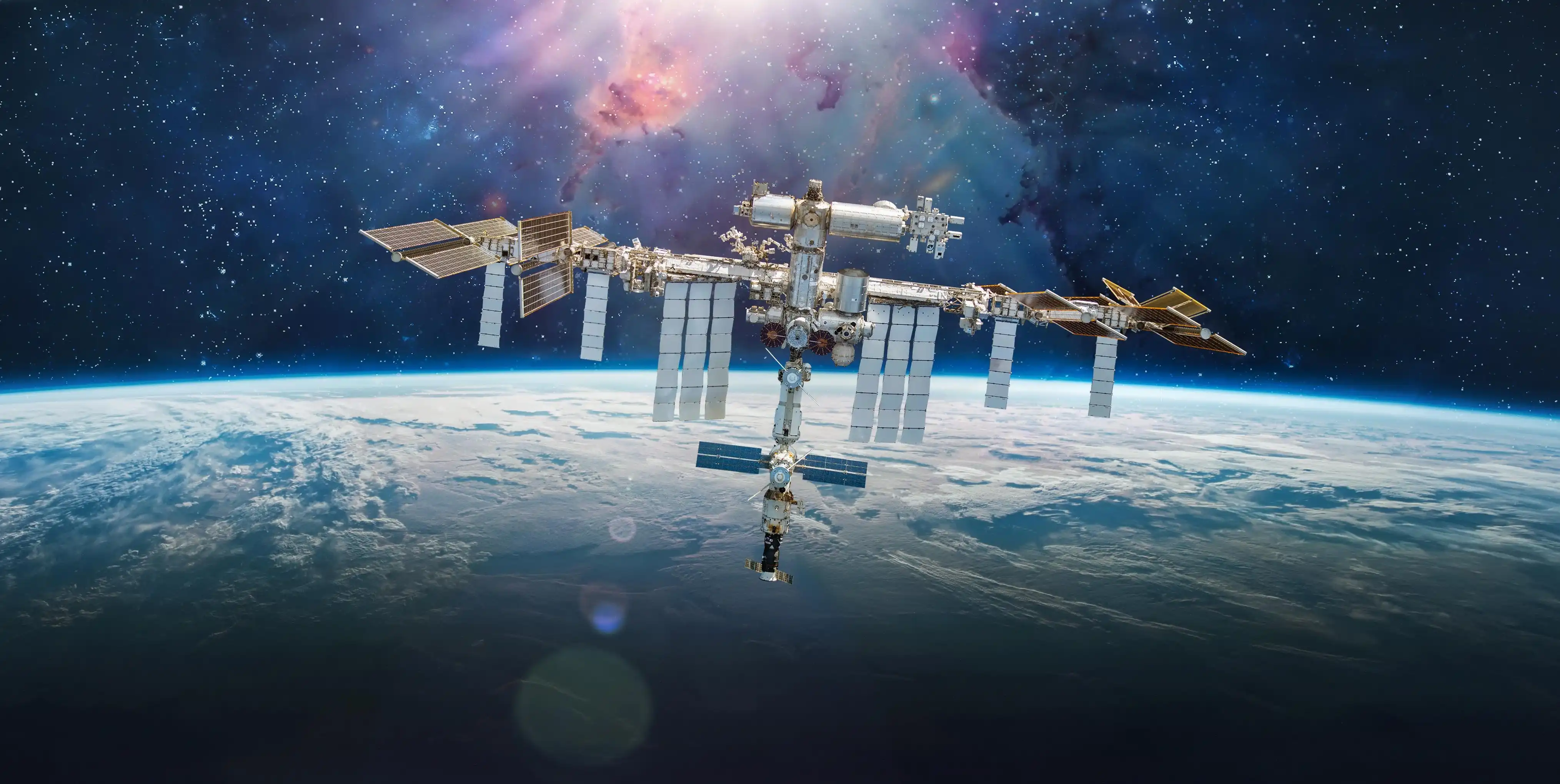
India has quietly crossed a critical threshold in space capability. For the first time, a domestically built and operated private satellite has successfully captured images of another object in orbit — the International Space Station — marking India’s entry into a highly sensitive and strategically valuable domain often referred to as in-orbit snooping or space watch.
The breakthrough has been achieved by Azista Space, an Indian aerospace firm that demonstrated the ability to track, task, and image a fast-moving object in low Earth orbit from another satellite — a capability until now dominated by a handful of global space powers.
What Actually Happened
Using its 80-kg Earth-observation satellite ABA First Runner (AFR), Azista Space successfully captured multiple images of the ISS while both objects were in orbit, separated by distances ranging between 250 km and 300 km.
The satellite executed two independent tracking attempts under sunlit conditions, capturing the ISS in 15 distinct frames with 100% success. The resulting imagery achieved 2.2-metre spatial sampling, validating not just optical resolution but, more importantly, precision tracking algorithms and orbital tasking accuracy.
This was not a coincidence shot. It was a planned, calculated demonstration of control, timing, and sensor capability.
Why This Is a Big Deal
Imaging the ISS is not about curiosity or prestige. It is a technical stress test.
Objects in low Earth orbit move at roughly 7.6 km per second. Successfully imaging one satellite from another requires:
-
Extremely accurate orbital prediction
-
Real-time tasking of sensors
-
Stabilisation and pointing precision
-
Advanced image processing under tight time windows
In simple terms, this proves that India now has eyes in orbit that can look at other eyes in orbit.
Strategic Context: Space Is No Longer Peaceful
India currently operates 50+ active satellites across communication, navigation, Earth observation, and surveillance. As orbital congestion increases and geopolitical tensions spill beyond Earth, knowing who is near your assets — and what they are doing — is no longer optional.
This capability directly strengthens India’s Space Situational Awareness (SSA), which involves:
-
Monitoring satellites and space debris
-
Predicting collision risks
-
Detecting unusual orbital behaviour
-
Enabling evasive manoeuvres to protect assets
Until now, SSA was largely a state-controlled, defence-driven space. This demonstration shows private Indian firms are now technically capable of contributing to that ecosystem.
The Satellite Behind the Feat
AFR was launched in June 2023 aboard a SpaceX Falcon-9 rocket as part of the Transporter-8 mission. It has already spent 2.5 years in orbit, making this achievement even more notable — the satellite is not new, experimental hardware but a mature platform still delivering cutting-edge results.
Azista Space operates a satellite and payload manufacturing facility in Sanand, Gujarat, and positions itself as Asia’s first private satellite factory with the capacity to produce up to 50 satellites annually.
Its engineering teams have also contributed to over a dozen ISRO missions, quietly building experience long before this public milestone.
Reading Between the Orbits
This development sends three clear signals:
-
India’s private space sector is no longer limited to launches and components
-
Advanced orbital intelligence is no longer the monopoly of state agencies
-
Future space security will be hybrid — public capability reinforced by private precision
In a world where satellites can be inspected, shadowed, or potentially interfered with, visibility itself becomes deterrence.
The Nation With Tea Take
For years, India talked about becoming a serious space power while outsourcing most “serious” capabilities to a few government institutions. This moment quietly flips the script.
No chest-thumping. No dramatic countdowns. Just a satellite doing its job — and proving that India can now see what moves above it.
That is how real space power announces itself.
you may also like


- March 03, 2026
Gulf Tensions Rise; Evacuation Flights Reach India

- March 03, 2026
Chhattisgarh Private Schools Announce RTE Protest
- March 02, 2026
India Rejects Report Linking Officials to Nijjar Killing

- March 02, 2026