

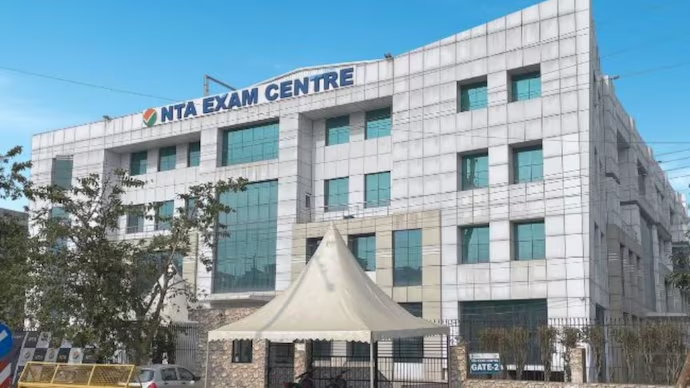
The National Testing Agency (NTA), which conducts some of India’s largest entrance examinations, operates with only 39 permanent employees, the Central government has informed Parliament. Despite its lean permanent workforce, the agency has managed more than 270 examinations involving over 6.6 crore candidate registrations since its inception in 2018.
The disclosure came in a written reply in the Rajya Sabha, offering a closer look at how India’s premier examination body manages large-scale recruitment and entrance tests with a limited permanent establishment.
NTA Relies on Deputation and Contractual Workforce
According to the government, all 39 sanctioned permanent posts in the NTA are filled through deputation. These positions include senior administrative and technical roles such as the Director General, Joint Secretaries, Directors, Deputy Directors, Assistant Directors and research personnel.
To support its day-to-day operations, the agency also depends on a much larger temporary workforce. It currently employs 73 contractual professionals, including consultants, software developers, advisors and young professionals, along with 124 outsourced personnel working in areas such as data analysis, legal support, administration and housekeeping.
For every examination cycle, the NTA further mobilises thousands of field-level officials, including observers, city coordinators, centre superintendents and members of state and district coordination committees. These officials are deployed in partnership with state governments, Kendriya Vidyalayas, Navodaya Vidyalayas and higher educational institutions across the country.
Over 270 Exams Conducted Since 2018
Since its establishment, the NTA has significantly expanded its responsibilities by conducting entrance examinations for higher education institutions across India.
The government informed Parliament that the agency has organised more than 270 examinations since 2018, covering over 6.6 crore candidate registrations.
In 2026 alone, the testing body has already conducted 12 major examinations, attracting over 65 lakh registrations, demonstrating the increasing scale of its operations.
NEET UG 2026 Highlighted as Example
The Centre cited NEET UG 2026 to illustrate the complexity of the agency’s examination process.
The medical entrance examination was conducted on May 3 across 5,432 examination centres located in 565 cities in 13 languages. Following a re-examination held on June 21, the final results were declared on July 16.
The figures underscore the logistical challenges involved in coordinating nationwide examinations that involve millions of students simultaneously.
Government Creates Additional Senior Posts
Acknowledging the expanding workload, the government said it has approved 16 additional senior-level positions to strengthen the agency’s administrative structure.
Officials explained that many modern examination bodies worldwide follow a similar model, maintaining a relatively small permanent workforce while outsourcing technology, logistics, cybersecurity, question paper management and evaluation to specialised agencies.
This allows organisations to scale operations efficiently during examination seasons without maintaining a large permanent payroll throughout the year.
NTA’s Financial Scale Continues to Grow
The agency’s financial data also reflects its expanding responsibilities.
Government figures show NTA reported an income of ₹1,116.84 crore during 2023-24, while expenditure stood at ₹1,040.95 crore. In comparison, its income was ₹504.16 crore and expenditure ₹440.20 crore in 2019-20.
The steady increase indicates the growing scale of India’s national entrance examination ecosystem and the resources required to conduct secure, technology-driven tests for millions of aspirants each year.
As the NTA continues to oversee high-stakes examinations such as NEET UG, JEE Main and CUET, the latest disclosure has renewed attention on the agency’s staffing model and operational capacity amid rising demand for transparent and efficient entrance testing.
Frequently Asked Questions (FAQs)
1. How many permanent employees does the NTA have?
The National Testing Agency (NTA) has 39 permanent employees, all of whom are serving on deputation, according to information shared by the Centre in the Rajya Sabha.
2. How many examinations has the NTA conducted since 2018?
Since its establishment in 2018, the NTA has conducted more than 270 examinations, covering over 6.6 crore candidate registrations across India.
3. How does the NTA conduct large-scale exams with only 39 permanent staff?
The agency relies on a combination of contractual employees, outsourced personnel, technology partners, and thousands of field-level officials, including observers, city coordinators, centre superintendents, and state coordination committees during examination cycles.
4. Which major exams are conducted by the NTA?
The NTA conducts several national-level entrance examinations, including NEET UG, JEE Main, CUET UG, CUET PG, UGC NET, CMAT, GPAT, and other recruitment and entrance tests assigned by the government.
5. Has the government increased NTA’s staffing?
Yes. The Centre informed Parliament that 16 additional senior-level posts have been created to strengthen the agency’s administrative and operational capacity.
6. How many candidates registered for NTA exams in 2026?
The government said the NTA has conducted 12 examinations in 2026 so far, with more than 65 lakh candidate registrations.
7. What was the scale of NEET UG 2026?
NEET UG 2026 was conducted at 5,432 examination centres across 565 cities in 13 languages, making it one of the largest entrance examinations in the country.
8. Why is NTA’s staffing model drawing attention?
The disclosure has sparked discussion because the agency manages India’s biggest entrance examinations with a very small permanent workforce, relying heavily on contractual staff and outsourced operations while handling millions of candidates every year.
Leave a Reply