

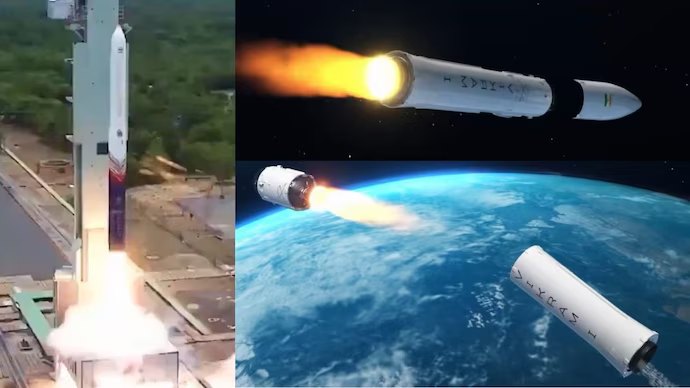
Skyroot Aerospace has achieved a historic milestone by successfully placing its Vikram-1 rocket into orbit, making it the first privately developed Indian launch vehicle to accomplish the feat. The landmark mission, known as Mission Aagaman, has not only strengthened India’s position in the global commercial space industry but has also highlighted the role of Telangana’s innovation ecosystem in supporting deep-tech startups.
The successful launch has brought Hyderabad-based startup incubator T-Hub into the spotlight, demonstrating how sustained mentorship, infrastructure, and startup support can help transform ambitious ideas into globally competitive technologies.
Vikram-1 Creates History for India’s Private Space Industry
Vikram-1 lifted off from the Satish Dhawan Space Centre in Sriharikota on July 18, 2026, successfully placing its payload into a 450-kilometre orbit on its maiden flight.
With this achievement, Skyroot Aerospace became the first private Indian company to design, develop, and launch an indigenous orbital-class rocket into space.
The successful mission also placed India among a select group of countries with proven private-sector orbital launch capabilities, marking a major step forward in the country’s growing commercial space sector.
How T-Hub Supported Skyroot’s Growth
Founded in 2018 by former ISRO scientists Pawan Kumar Chandana and Naga Bharath Daka, Skyroot Aerospace began its journey as an incubated startup at T-Hub, Hyderabad’s flagship innovation centre.
During its early years, the company received business mentoring, networking opportunities, investor access, and strategic guidance that helped accelerate product development and business growth.
As the company moved from concept design to rocket development, engineers also utilised facilities at T-Works, Telangana’s prototyping centre, where critical aerospace components could be rapidly designed, manufactured, and tested.
The startup also benefited from the state’s broader innovation ecosystem, which includes WE-Hub, TASK, Research and Innovation Circle of Hyderabad (RICH), and the Telangana State Innovation Cell (TSIC), all focused on promoting entrepreneurship, research, skill development, and industry collaboration.
Skyroot’s Journey Before Vikram-1
Skyroot first gained national attention in November 2022 when it successfully launched Vikram-S, India’s first privately built rocket. The mission came soon after the Indian government opened the space sector to private participation, creating new opportunities for commercial space companies.
The company continued its rapid growth over the following years. In May 2026, Skyroot became India’s first space-tech unicorn, achieving a valuation of more than $1.1 billion.
The successful orbital mission of Vikram-1 now represents the company’s biggest accomplishment to date, proving that Indian private enterprises can independently build advanced launch vehicles capable of reaching orbit.
Leaders Welcome the Historic Achievement
The successful launch received widespread appreciation from political leaders and industry stakeholders.
Former Telangana IT and Industries Minister K.T. Rama Rao (KTR) congratulated the Skyroot team and praised the state’s long-term investment in startup infrastructure. He highlighted the importance of institutions such as T-Hub and T-Works in nurturing technology-driven companies capable of competing on the global stage.
The mission has also been viewed as a strong endorsement of Telangana’s strategy to promote innovation-led economic growth.
What Vikram-1 Means for India’s Space Industry
Industry experts believe Vikram-1’s success could significantly boost investor confidence in India’s rapidly expanding private space sector.
The achievement is expected to encourage greater investment in startups working on launch vehicles, satellite manufacturing, propulsion systems, reusable technologies, and aerospace engineering.
The mission also reinforces Hyderabad’s reputation as one of India’s leading centres for deep-tech innovation and advanced aerospace research.
A New Era for India’s Commercial Space Ambitions
Skyroot Aerospace’s remarkable journey from a startup incubated in Hyderabad to the company behind India’s first privately developed orbital rocket reflects the growing strength of the country’s innovation ecosystem.
The success of Mission Aagaman demonstrates that collaboration between startups, government-backed innovation centres, investors, and research institutions can accelerate technological breakthroughs. As India’s commercial space industry continues to expand, Vikram-1 is expected to inspire a new generation of entrepreneurs working on cutting-edge aerospace technologies.
Frequently Asked Questions (FAQs)
1. What is Vikram-1?
Vikram-1 is Skyroot Aerospace’s orbital launch vehicle and the first privately developed Indian rocket to successfully place a payload into orbit.
2. What is Mission Aagaman?
Mission Aagaman is the inaugural orbital mission of Skyroot Aerospace’s Vikram-1 rocket, which successfully reached a 450-kilometre orbit.
3. Why is Vikram-1’s launch historic?
It marks the first time an Indian private company has successfully built and launched an indigenous orbital rocket into space.
4. What role did T-Hub play in Skyroot’s journey?
T-Hub provided incubation support, mentorship, investor connections, and business guidance during Skyroot Aerospace’s early stages.
5. What is T-Works?
T-Works is Telangana’s prototyping centre, where startups can design, manufacture, and test engineering prototypes and hardware.
6. Who founded Skyroot Aerospace?
Skyroot Aerospace was founded in 2018 by former ISRO scientists Pawan Kumar Chandana and Naga Bharath Daka.
7. What was Skyroot’s first rocket?
Skyroot’s first rocket was Vikram-S, which became India’s first privately built rocket to launch in 2022.
8. When did Skyroot become a unicorn?
Skyroot Aerospace became India’s first space-tech unicorn in May 2026 after achieving a valuation exceeding $1.1 billion.
9. Why is Vikram-1 important for India’s space sector?
The mission demonstrates the capability of Indian private companies to develop orbital launch systems, strengthening the country’s commercial space industry.
10. How will Vikram-1’s success impact the future?
The achievement is expected to attract more investment, encourage new space-tech startups, and accelerate innovation in India’s rapidly growing aerospace sector.
Leave a Reply