


- March 03, 2026
Bangladesh Election 2026: Counting Begins
Bangladesh Election 2026 voting ends with 47.91% turnout. Counting underway as Hasina calls polls a farce and BNP-Jamaat face off.
- February 12, 2026
- in International
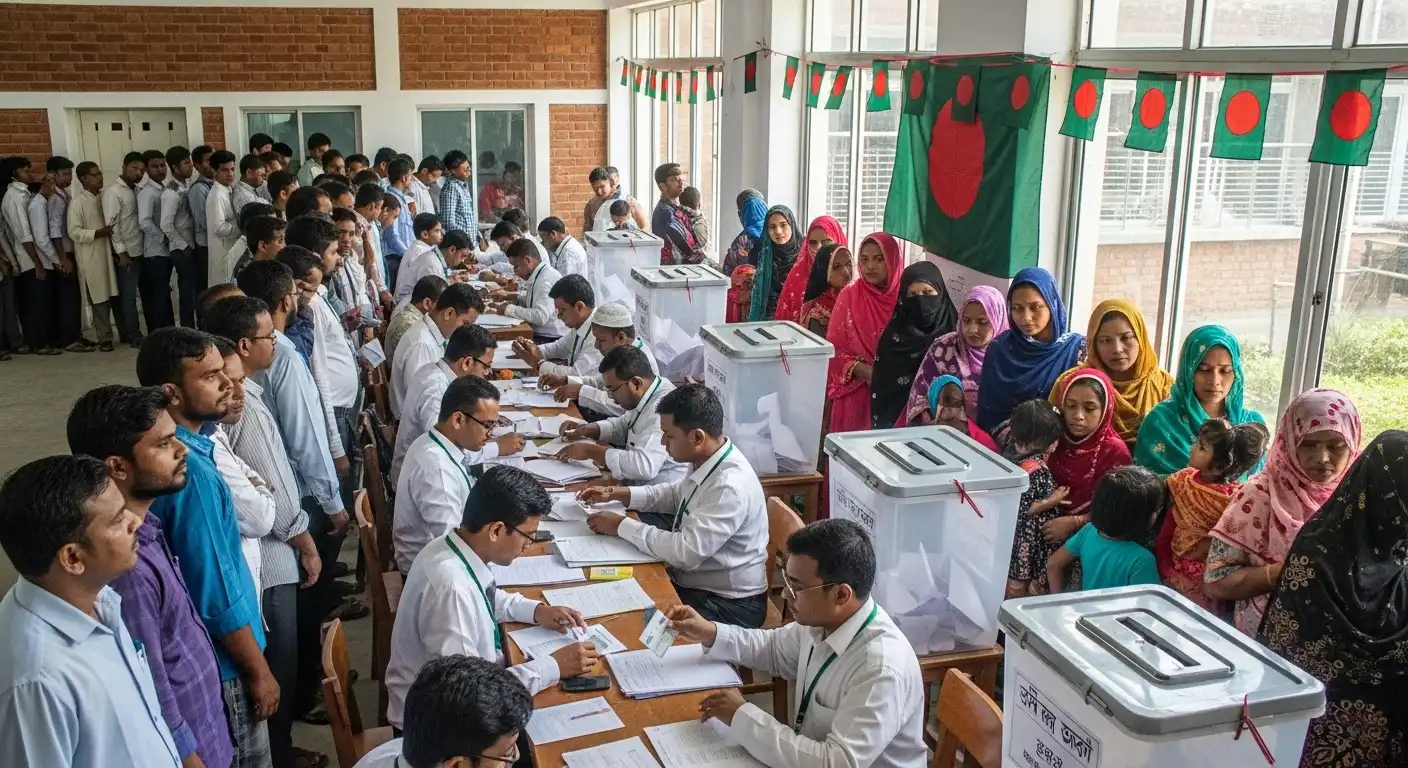
Voting for the Bangladesh General Election 2026 ended on Thursday at 4:30 pm local time, and counting of votes has begun across the country.
According to officials from the Election Commission, voter turnout stood at 47.91% as of 2 pm. Authorities said final figures may change as reports from some polling centres are still being compiled. Early trends are expected overnight, while final results are likely to be declared on Friday.
Direct Contest After Awami League Ban
This election is significant as it is the first in 30 years without the Awami League’s traditional “boat” symbol on the ballot. The party was barred from contesting after the 2024 political developments that led to the removal of former Prime Minister Sheikh Hasina.
The main contest is between Tarique Rahman’s Bangladesh Nationalist Party (BNP) and an 11-party alliance led by Jamaat-e-Islami. With Awami League absent, the political landscape has shifted sharply.
Hasina Calls Polls a “Farce”
Former Prime Minister Sheikh Hasina described the election as a “well-planned farce” conducted without her party. In a statement, she said early low turnout figures showed public rejection of the process.
She cited Election Commission data stating that only 14.96% of voters had cast ballots by 11 am. However, turnout increased later in the day, with officials reporting 47.91% participation by mid-afternoon.
Yunus Praises Peaceful Voting
Bangladesh Chief Adviser Muhammad Yunus praised voters and institutions for what he described as a peaceful electoral process. He said the participation of citizens reflected continued commitment to democracy.
Yunus also described the day as marking a “new Bangladesh,” calling it an important moment for the country’s political transition.
National Referendum Held Alongside Polls
Voters cast two ballots — one for the national parliamentary election and another for a National Referendum.
The referendum will determine whether the proposed July National Charter is adopted. The charter, prepared by a National Consensus Commission under the interim government, reportedly outlines constitutional and legal reforms following the 2024 student-led movement.
White ballots were used for the parliamentary election, while pink ballots were used for the referendum.
Security and Isolated Incidents
The Election Commission deployed nearly one million security personnel across 36,031 polling centres nationwide. More than 127 million people were eligible to vote, and 1,981 candidates contested.
Officials said polling was largely peaceful. However, some incidents were reported during the day.
Authorities confirmed that five people were held after a crude bomb blast at a polling station in Munshiganj. In separate reports, four people reportedly died in different districts during polling hours. The exact circumstances were not immediately detailed.
Two individuals were also detained in Sherpur after more than 100 allegedly stamped ballot papers were recovered from a polling centre. Officials are investigating the matter.
BNP and Jamaat-e-Islami both alleged voting irregularities in certain areas. Jamaat leaders claimed attempts were made to cast fake votes, while BNP leaders referred to “unwanted incidents.” Election authorities have not confirmed large-scale disruptions.
Key Issues in the Election
The election follows a period of political unrest and economic pressure. Major campaign themes included corruption, employment, inflation and economic development.
The outcome is expected to shape Bangladesh’s political direction after nearly two years of instability.
What Happens Next?
Vote counting is underway, and the Election Commission has indicated that initial results may emerge overnight. Final official results are expected on February 13.
As Bangladesh awaits the outcome, attention remains focused on whether the process will be widely accepted by all major political stakeholders.
you may also like


- March 02, 2026
Trump Says Iran Operations May Last 4–5 Weeks
- March 02, 2026
How Switzerland Became the World’s Most Nuclear-Ready Nation

- March 02, 2026
Middle East War Escalates; Oil, Air Travel Hit
- March 02, 2026