


- March 03, 2026
IAF Showcases S-400, Akash at Vayu Shakti 2026
At Vayu Shakti 2026 in Pokhran, the Indian Air Force displayed S-400, Akash, Sukhoi and integrated air defence systems amid China-Pakistan concerns.
- March 02, 2026
- in National
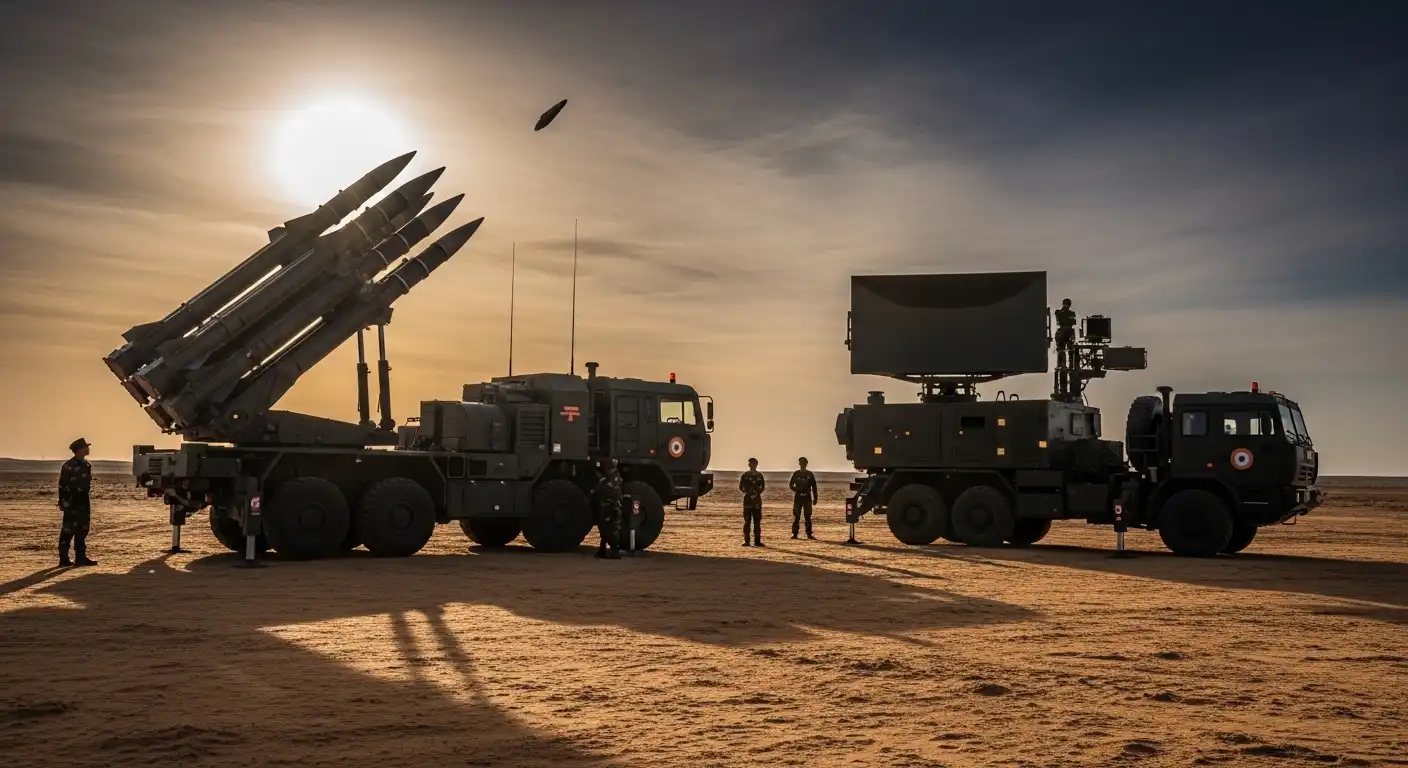
In the Thar desert’s Pokhran Air-to-Ground Range, the Indian Air Force (IAF) demonstrated its expanding aerial combat capability during Vayu Shakti-2026.
Held in the presence of President Droupadi Murmu, Defence Minister Rajnath Singh and senior military officials, the exercise was presented as a demonstration of preparedness and integration rather than a ceremonial display.
Simulated Combat Scenario
The day-to-night drill recreated near-real combat conditions. Simulated targets included runways, radar installations, bunkers, fuel depots, armoured convoys and command centres spread across a three-kilometre layout.
IAF officials described the sequence as reflective of operational templates used in Operation Sindoor. The exercise showcased synchronised fighter strikes, suppression of enemy air defence (SEAD) missions, decoy manoeuvres and night-time targeting drills.
Surface-to-air missile engagements, including the firing of an Akash missile, were also part of the demonstration.
S-400 ‘Sudarshan’ in Focus
The long-range S-400 air defence system, inducted from Russia and referred to domestically as ‘Sudarshan’, was a central highlight.
According to previous IAF briefings, the system is capable of detecting aerial threats at extended ranges and engaging multiple targets simultaneously using different missile types.
Officials have earlier stated that during Operation Sindoor, the S-400 conducted a long-range interception. Detailed operational specifics remain classified.
The system forms the outer layer of India’s air defence grid and is integrated with radar networks and the Integrated Air Command and Control System (IACCS).
Indigenous Systems on Display
The Akash surface-to-air missile system, developed by the Defence Research and Development Organisation (DRDO), demonstrated medium-range interception capability.
IAF officials said Akash is designed to engage aircraft, drones and cruise missiles, and can be deployed to protect airbases and key installations. The newer Akash-NG variant features upgraded guidance and electronic resistance capabilities.
The Barak-8 missile system, developed jointly with Israel Aerospace Industries, also forms part of India’s layered defence architecture, bridging medium- and long-range air defence.
Multi-Platform Air Power
Beyond missile systems, Vayu Shakti-2026 highlighted integrated air operations involving fighter jets, attack helicopters, transport aircraft and special forces.
Frontline fighters such as the Sukhoi Su-30MKI carried out precision strike simulations. The Dassault Mirage 2000 and SEPECAT Jaguar performed coordinated attack profiles targeting simulated high-value assets.
Rotary-wing platforms including the indigenously developed HAL Prachand and the Boeing AH-64 Apache demonstrated close air support operations.
Transport and logistics capability was represented by aircraft such as the Airbus C-295, which simulated troop deployment and reinforcement operations.
Strategic Signalling
Defence analysts view Vayu Shakti as both a readiness drill and a strategic message.
India faces a complex security environment involving both western and northern borders. Military officials have emphasised that modern air warfare depends not only on advanced platforms but also on network-centric coordination across multiple systems.
The exercise underscored a layered air defence approach — combining long-range imported systems, indigenous missile shields and integrated command structures.
While operational details remain limited for security reasons, Vayu Shakti-2026 offered a public snapshot of how India is strengthening its aerial deterrence posture.
you may also like

- March 02, 2026
India Rejects Report Linking Officials to Nijjar Killing
- March 02, 2026
Delhi Man Allegedly Killed, Body Dumped in Yamuna
- March 02, 2026
India Rushes Relief Flights Amid West Asia Crisis

- March 02, 2026