


- March 09, 2026
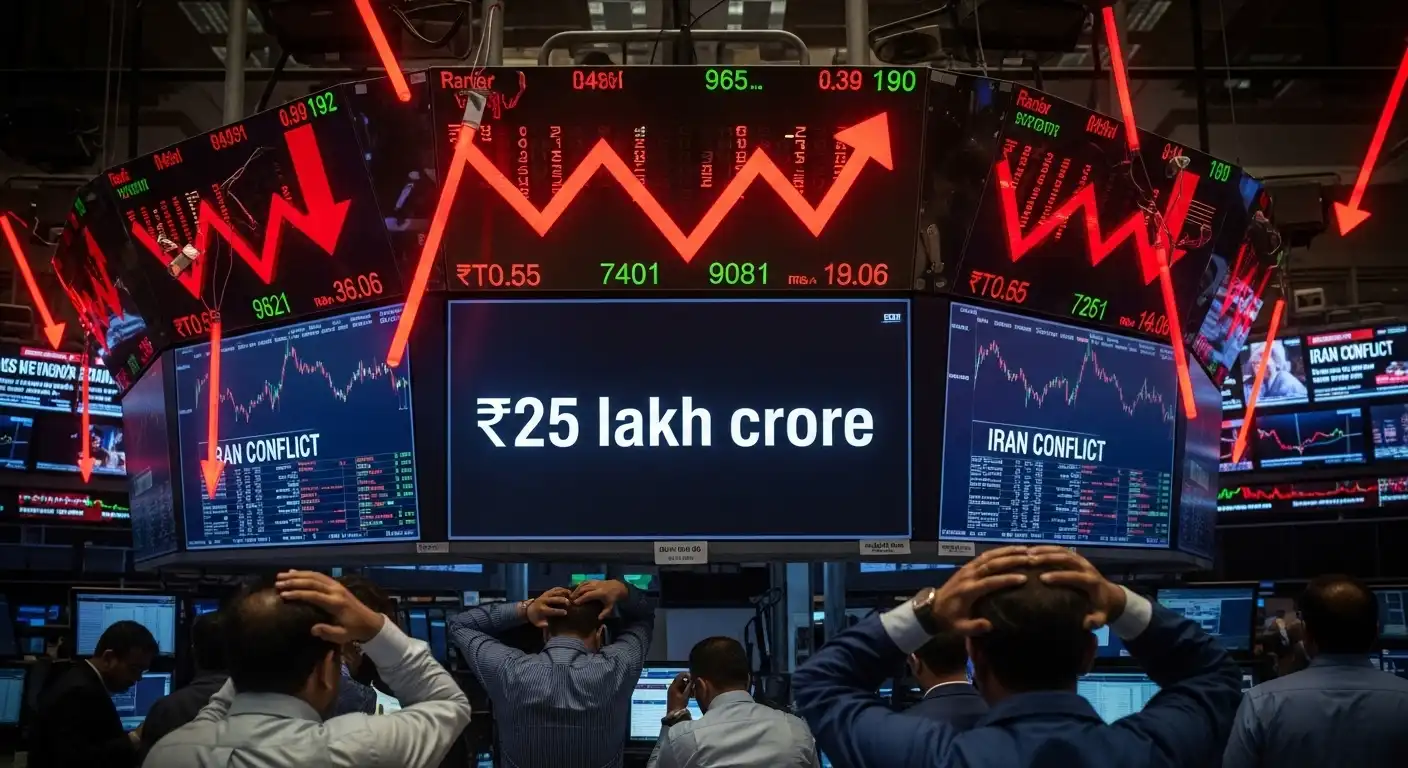
Iran conflict wipes ₹25 lakh crore from markets
Escalating Iran conflict triggers stock market sell-off, wiping over ₹25 lakh crore from investor wealth in just five trading sessions.
- March 09, 2026
- in Business
Advertisement

India’s stock market has witnessed a sharp decline over the past week as escalating geopolitical tensions linked to the Iran conflict triggered heavy selling across equities.
According to market data, more than ₹25 lakh crore in investor wealth has been wiped out in just five trading sessions as benchmark indices Sensex and Nifty continued to fall.
The decline has been driven largely by a surge in global crude oil prices and growing uncertainty in financial markets.
Sharp fall in Sensex and Nifty
During intraday trading on Monday, the S&P BSE Sensex fell as much as 2,494 points, reaching 76,424.55. Meanwhile, the NSE Nifty 50 dropped to an intraday low of 23,697.80, reflecting broad selling across the market.
The downturn comes as crude oil prices climbed close to $120 per barrel, raising concerns about inflation and economic stability.
Higher oil prices often impact investor sentiment in India because the country relies heavily on imported crude.
Market value drops significantly
The combined market capitalisation of all companies listed on the Bombay Stock Exchange has declined sharply since the conflict intensified.
Market estimates show the total value of listed companies has fallen from around ₹463.9 lakh crore to below ₹440 lakh crore.
With Monday’s continued decline, the total wealth erosion in Indian equities has crossed ₹25 lakh crore.
Continuous selling over the past week
Indian equity markets have faced consistent pressure since the beginning of March.
The Nifty 50 index dropped sharply in the first trading session after the conflict began, falling more than 685 points.
Further selling on March 4 pushed the index down again, marking one of the steepest two-day declines since the market crash seen during the COVID-19 pandemic in 2020.
Although markets saw a temporary recovery on March 5, selling resumed the following day, resulting in a weekly loss of more than 1,100 points for the Nifty.
Foreign investors pull out funds
Foreign institutional investors (FIIs) have been significant sellers during this period.
Between March 2 and March 6, overseas investors reportedly withdrew around ₹21,000 crore from Indian equities.
Market analysts say foreign investors often shift funds to safer assets during periods of global uncertainty, which can intensify declines in emerging markets like India.
Sectoral impact across industries
The market decline has affected several sectors, particularly financial stocks and consumer-related companies.
Airline companies have also been impacted due to rising fuel prices. Shares of InterGlobe Aviation, which operates IndiGo, have reportedly fallen by more than 7% as jet fuel costs increased.
Banking stocks have also declined as expectations of interest rate cuts by the Reserve Bank of India may be delayed due to inflation concerns.
However, a few companies linked to commodities and energy have shown relative resilience, as higher oil and resource prices may support their revenues.
Economic concerns linked to oil prices
Analysts say the surge in crude oil prices could have broader economic implications for India.
If oil prices remain around $120 per barrel, it could increase the country’s fiscal deficit and raise production costs for businesses.
Higher energy costs may also contribute to inflation, which could create additional challenges for policymakers and financial markets.
What investors are watching
Market experts say future market direction will depend largely on developments in the geopolitical situation and energy markets.
Domestic institutional investors have helped absorb part of the foreign investor selling, which analysts say has helped prevent even sharper declines.
However, if oil prices remain elevated for a longer period, some analysts have warned that equity markets could face additional pressure in the coming months.
Advertisement
you may also like

- March 09, 2026
IMF warns Iran conflict could raise global inflation

- March 09, 2026
Sensex, Nifty hit 11-month low amid oil price surge

- March 08, 2026
Jio IPO May Miss Timeline Over SEBI Rule Delay

- March 08, 2026