


- March 03, 2026
Scientists Rebuild 31-Foot ‘Dinosaur-Killer’ Crocodile From Fossil Evidence
Scientists reconstruct a 31-foot Deinosuchus crocodile, revealing how the prehistoric predator hunted dinosaurs in ancient wetlands.
- February 09, 2026
- in International
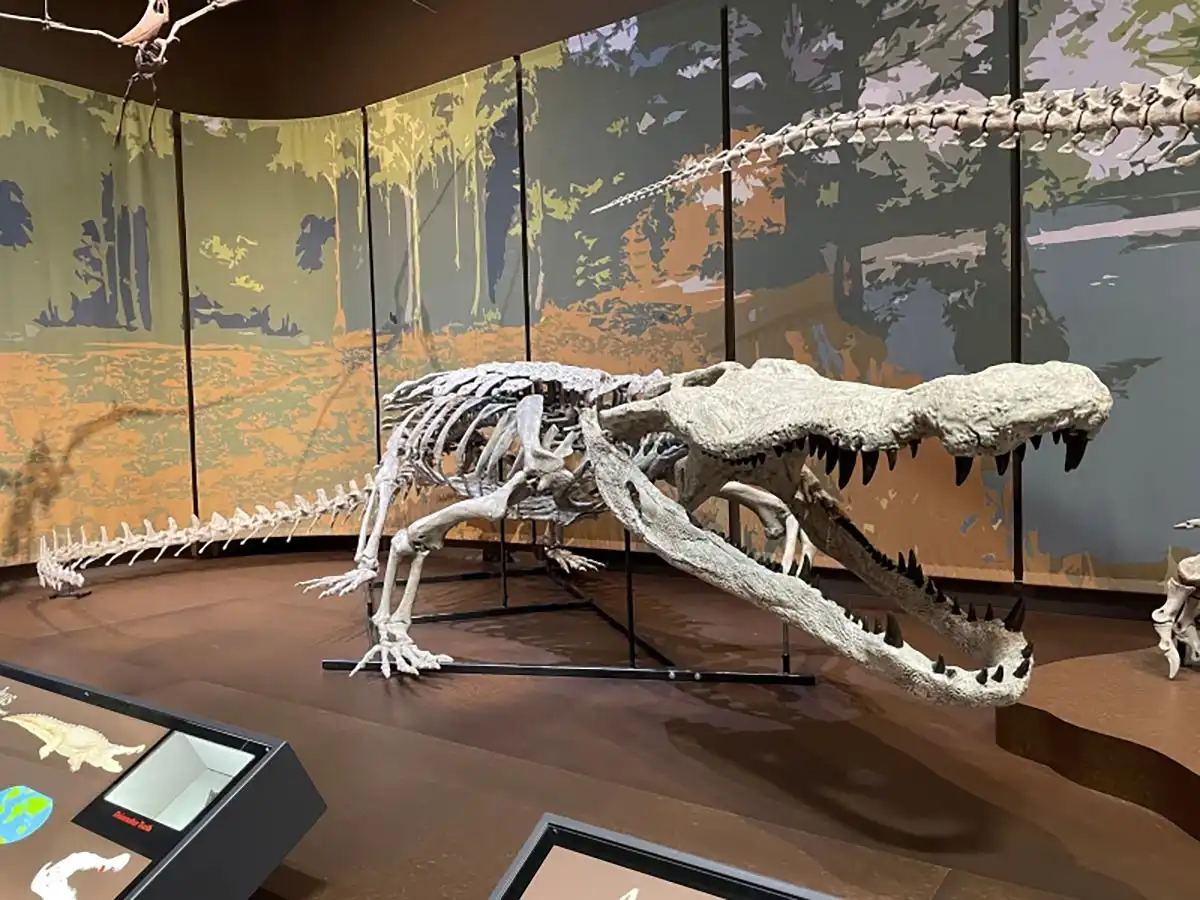
Long before humans argued about apex predators, crocodiles quietly solved the debate. Scientists have now reconstructed a 31-foot prehistoric crocodilian, popularly nicknamed the “Dinosaur-killer”, offering one of the most evidence-driven looks yet at a predator that once ruled Late Cretaceous wetlands.
The animal in question is Deinosuchus schwimmeri, a colossal relative of modern alligators that lived roughly 83–76 million years ago. A newly installed, life-sized mounted skeleton at the Tellus Science Museum brings this long-extinct hunter back into physical reality — not as a Hollywood monster, but as a scientifically grounded reconstruction.
Not a Movie Monster, a Verified Killer
For decades, Deinosuchus was surrounded by exaggeration. Oversized jaws, cartoon proportions, and speculative artwork dominated public imagination. This new reconstruction deliberately avoids that trap.
The skeleton is based on fossil measurements, comparative anatomy, and high-resolution 3D scans, rather than artistic bravado. It shows an animal approximately 30–31 feet long, weighing several tonnes, with massive osteoderms (armour plates) and a skull built for bone-crushing force.
This wasn’t a crocodile that waited politely for leftovers.
Yes, It Hunted Dinosaurs
Fossil evidence confirms bite marks on dinosaur bones that match Deinosuchus dentition. These marks are not random scratches — they show crushing pressure and tooth spacing consistent with active predation, not scavenging.
When large dinosaurs approached water sources, they weren’t stepping into a peaceful ecosystem. They were entering ambush territory.
In Late Cretaceous North America, coastal plains and shallow seas dominated the landscape. Deinosuchus controlled these zones, occupying the ecological position modern crocodiles still aspire to — only on a much larger, more violent scale.
Decades of Work Behind One Skeleton
The reconstruction draws heavily on more than 40 years of research by palaeontologist David Schwimmer, whose fieldwork began in the late 1970s.
Fossils collected across Georgia, Alabama, and Texas, now housed in institutions like the Smithsonian and the American Museum of Natural History, allowed scientists to move beyond isolated bones and toward a full anatomical picture. Funding support from National Geographic played a key role in enabling long-term excavation and analysis.
This is slow science — the kind that waits for evidence instead of applause.
A Species With an Identity
Until recently, Deinosuchus fossils from across North America were lumped into a single species. That changed in 2020, when researchers formally identified Deinosuchus schwimmeri as a distinct eastern species.
This clarification resolved long-standing taxonomic confusion and acknowledged subtle but important differences between eastern and western fossil remains. The museum reconstruction reflects only the eastern species, making it one of the most taxonomically precise displays ever produced for this animal.
Built With Precision, Not Drama
The skeleton was created in collaboration with Triebold Paleontology, specialists in museum-grade fossil replicas. Every missing bone was inferred conservatively, using known anatomical limits and comparisons with close relatives.
Joint angles, posture, and armour placement reflect how the animal likely moved, floated, and struck, rather than how it might look most terrifying under spotlight lighting.
The result is unsettling not because it is exaggerated — but because it is believable.
What This Changes
This reconstruction forces a recalibration of how we understand prehistoric food chains. Deinosuchus was not a side character living alongside dinosaurs. It was an equal-opportunity predator, capable of killing large terrestrial animals when conditions aligned.
It also reminds us of an uncomfortable truth:
Evolution does not reward size alone — it rewards placement, patience, and power.
The Nation With Tea Take
Dinosaurs usually get the headlines. But this reconstruction quietly flips the narrative.
While dinosaurs ruled land and sky, crocodiles perfected the waiting game. No feathers. No speed records. Just jaw strength, timing, and water.
Seventy-six million years later, dinosaurs are museum legends.
Crocodiles are still here — smaller, calmer, and watching.
you may also like


- March 02, 2026
Trump Says Iran Operations May Last 4–5 Weeks

- March 02, 2026
How Switzerland Became the World’s Most Nuclear-Ready Nation

- March 02, 2026
Middle East War Escalates; Oil, Air Travel Hit

- March 02, 2026