


- March 02, 2026
India Posts 7.8% GDP Growth Under New Series
India records 7.8% GDP growth in Q3 FY26 under a new base year series. Here’s what changed and what it means for becoming the 3rd largest economy.
- February 27, 2026
- in Business

India has reported 7.8% GDP growth for the third quarter of FY 2025–26, retaining its position as the fastest-growing major economy.
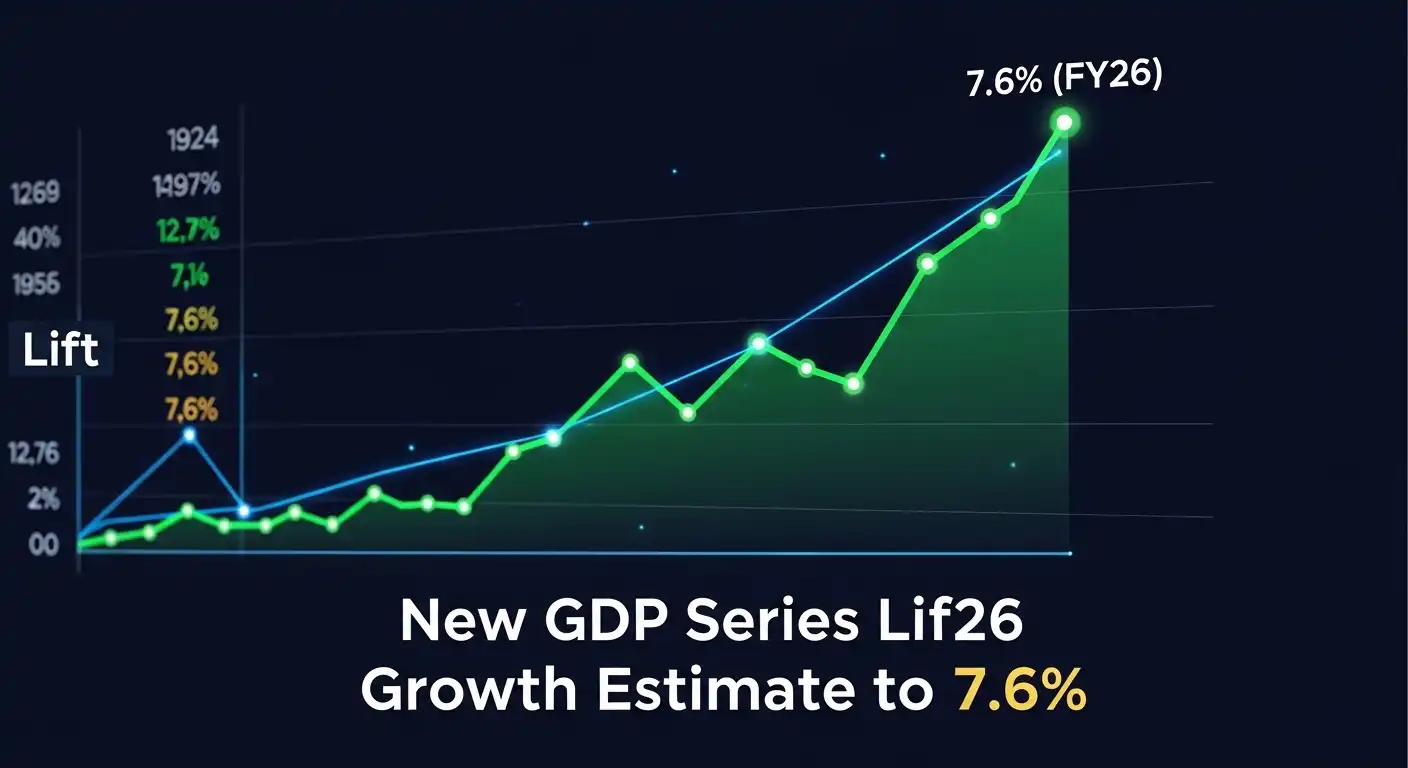
The data marks the first official release under a revised GDP series introduced by the Ministry of Statistics and Programme Implementation (MoSPI). Full-year growth for FY26 has been revised upward to 7.6%.
The updated series introduces key methodological changes aimed at improving accuracy and aligning India’s national accounts with global standards.
What Does 7.8% Growth Indicate?
Economists say the data suggests broad-based expansion.
Manufacturing and services showed strong momentum, while private consumption and investment grew above 7%, pointing to balanced demand-side growth.
Some experts noted that agriculture appeared softer in the quarter, partly due to changes in estimation methods.
Nominal growth remained below 9%, but analysts believe the strong real GDP print supports corporate earnings and fiscal stability.
What Has Changed in the New GDP Series?
The most important change is the revision of the base year from 2011–12 to 2022–23.
A base year acts as a reference year for calculating real growth by adjusting for inflation. Over time, price structures and economic patterns change. Updating the base year ensures that GDP calculations better reflect the current structure of the economy.
The revision follows concerns raised by the International Monetary Fund, which had earlier flagged India’s outdated base year.
Key Methodological Improvements
Under the new series, several major changes have been introduced:
1) Use of GST Data
Goods and Services Tax data will now be used more extensively to estimate corporate activity and cross-verify annual accounts. This is expected to improve accuracy, especially in the formal sector.
2) Better Informal Sector Measurement
Data from the Periodic Labour Force Survey (PLFS) and Annual Survey of Unincorporated Sector Enterprises (ASUSE) will be used to better capture informal sector activity.
3) Double Deflation Method
For sectors such as agriculture and manufacturing, output and input prices are now adjusted separately. This helps isolate real value addition more accurately.
4) Proportional Denton Method
Quarterly GDP calculations now use a more refined benchmarking approach to reduce sudden data jumps and smooth revisions.
5) New Data Sources
e-Vahan vehicle registration data and Public Finance Management System (PFMS) data will be used to strengthen consumption and government expenditure estimates.
The government has also included activities such as domestic workers and gig economy participation under household sector estimation.
What It Means for India’s Global Rank
India is widely projected to overtake Japan to become the world’s fourth-largest economy by the end of FY26, according to IMF estimates earlier this year.
Chief Economic Adviser V. Anantha Nageswaran has indicated that India is on track to become a $4 trillion economy in the next financial year, provided growth remains in the 7–7.4% range.
However, exchange rate movements and global uncertainties may influence the timing of India’s rise in global rankings.
While India’s overall GDP size is expanding rapidly, its per capita income remains significantly lower compared to other top economies.
Why the Base Year Matters
Revising the base year ensures that economic indicators reflect structural changes in the economy. New industries, consumption patterns and taxation systems such as GST need to be incorporated into calculations.
MoSPI has stated that the revised GDP series aligns with international statistical standards and integrates Supply and Use Tables to reduce discrepancies between production and expenditure-based estimates.
The Bigger Picture
The 7.8% growth figure, combined with methodological upgrades, strengthens confidence in India’s economic data framework.
While global headwinds remain, analysts say the updated GDP series provides a clearer lens to track India’s journey toward becoming one of the world’s top three economies in the coming years.
you may also like

- March 02, 2026
Middle East Tensions: Impact on India Trade & Oil

- March 02, 2026
Intel CEO Warns of Huawei’s Chip Talent Push

- February 28, 2026
Amazon to Invest $50B in OpenAI, Expands AWS Tie-Up
- February 28, 2026