Shubhanshu Shukla Captures Earth’s Airglow From Space: What Is It?
Indian astronaut Shubhanshu Shukla highlighted the faint glow around Earth from space, offering a look at airglow and the science behind the phenomenon.
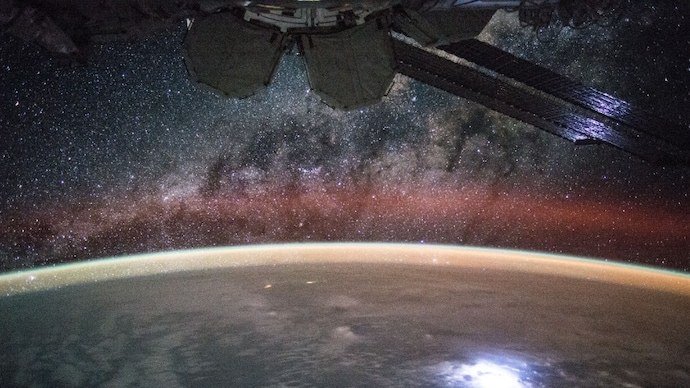
Indian astronaut Shubhanshu Shukla has highlighted a faint band of light surrounding Earth, drawing attention to a natural phenomenon known as airglow. Seen from orbit, the glow appears as a thin luminous layer along the planet’s curved horizon.
Airglow is produced when atoms and molecules in Earth’s upper atmosphere release energy as light. Solar radiation provides much of the energy driving these chemical processes. The phenomenon continues on the night side, where it is often referred to as nightglow.
The light is extremely faint from the ground but becomes easier to see from orbit against the darkness of space. Airglow can appear in different colours depending on the gases and chemical reactions involved. Green light is associated with atomic oxygen, while sodium can contribute yellow-orange shades.
Airglow is different from an aurora. Auroras occur when energetic particles linked to the solar wind interact with gases in the upper atmosphere, producing brighter displays mainly near the polar regions. Airglow is much more widespread and is driven largely by solar radiation and atmospheric chemistry.
The phenomenon is more than a spectacular view for astronauts. Scientists can study changes in its brightness and colour to learn about the composition, temperature and movement of Earth’s upper atmosphere.
Shukla’s view from space is a reminder that Earth’s atmosphere has its own subtle lighting system—no electricity bill required.